Steer your performance with reliable CRM reporting

Turn your marketing, sales and customer data into shared, readable KPIs your teams can actually use.

Talk to an expert See the case study
HubSpot Elite Partner
800+ clients supported
10+ years of HubSpot expertise
Challenges

A disputed number delays a decision.
A shared number triggers it.

CRM reporting is only valuable if it helps make the right decisions at the right time. Yet in many organizations, teams still spend considerable time checking, reprocessing or reconciling data before they can even analyze it. The real challenge is not producing more dashboards, but having reliable, shared, directly usable KPIs. High-performing CRM reporting rests above all on quality data, clear governance and consistent processes that let every team steer its activity with the same level of confidence.

Copernic CRM reporting expert

KPIs shared across the whole company

Marketing and sales alignment relies in particular on shared KPIs that let teams measure performance from the same reality. When each team calculates its own KPIs or reads the customer journey stages differently, dashboards quickly lose their value. Reliable CRM reporting creates a common language that eases conversations and supports a RevOps approach built on shared KPIs.


What we see

After 800+ CRM projects, we see that gaps between two reports rarely come from the dashboards themselves. They stem from different business definitions, inconsistent pipelines or calculation rules that were never harmonized. 

CRM and reporting expert

Data reliable enough to be used

Reporting quality depends directly on the quality of the data feeding it. Incomplete properties, duplicates, outdated information or an incomplete HubSpot integration mechanically produce inaccurate KPIs. Before creating a new dashboard, you must make data collection reliable, standardize information and automate its updates as much as possible.


What we see

Companies usually have far more data than they actually use. Conversely, some information essential to steering (opportunity source, sales stages, loss reasons or conversion data) remains incomplete or irregularly entered.

Copernic CRM dashboard expert

KPIs that make decisions easier

Good CRM reporting does not try to display as many KPIs as possible. It highlights the few KPIs that help quickly understand the situation, spot gaps and decide on next actions. Dashboards must be tailored to each management level: leadership, management, sales, marketing or customer service teams. 


What we see

Many companies already have dozens of dashboards. Yet managers keep exporting data to Excel to produce their own analyses, for lack of KPIs relevant or clear enough to meet their needs.

CRM data analysis expert

Continuous steering rather than one-off reporting

CRM reporting should not be seen as a document reviewed once a month in an executive committee. It becomes truly useful when it supports day-to-day decisions, measures progress continuously and quickly raises alerts when things drift. KPIs updated in real time let teams anticipate risks, track their goals and improve their performance for the long term.


What we see

The highest-performing organizations do not necessarily have more data than others. They have, however, defined clear governance, limited the number of high-value decision KPIs and automated their production so teams can spend their time analyzing rather than consolidating numbers.

CRM reporting: the foundation of truly reliable steering

CRM reporting is a set of dashboards, KPIs and reports built from your CRM data to track your company's performance. It centralizes marketing, sales and customer service information to offer a shared view of the business and make decisions easier.

At Copernic, we believe CRM reporting is not just about displaying numbers. It must faithfully reflect the company's operational reality. That takes reliable data, consistent processes, shared calculation rules and a CRM strategy able to structure the data model for the long term.

CRM reporting lets you track sales KPIs, marketing performance, lead quality, revenue forecasts, team activity and customer satisfaction. It helps leadership spot trends, detect gaps and make decisions faster.

 Performance management
 Sales KPIs
 CRM dashboards
 Data governance
01

Data collected

Marketing, sales and customer service data is centralized in the CRM.

02

Data structured

Properties, objects and stages are harmonized according to shared rules.

03

Calculation rules

KPIs rest on clearly documented definitions, filters and periods.

04

Shared KPIs

Teams follow the same dashboards and share one reading of performance.

05

Reliable decisions

Leadership spots gaps, prioritizes actions and steers faster.

You have the data. Decide with it.

Dashboards alone do not improve how a company is steered. The KPIs must also rest on reliable data, a coherent CRM model and shared calculation rules.

At Copernic, we support marketing, sales and executive leaders in structuring their CRM, making their data reliable and building reporting they can truly use.

Our vision

A dashboard decides nothing.
Let's start from your decisions.

High-performing CRM reporting does not depend on dashboards alone. It rests on structuring choices: a coherent data model, clear governance and a platform able to support your company's evolution. That is the vision we put into practice at Copernic.

Lead nurturing automation

The right KPIs before the right tools


We never start a project with dashboards. We first define the decisions your teams must make every day, then the KPIs actually needed to inform them. This approach guarantees steering aligned with your business challenges rather than with what a tool can do.

Our conviction: high-performing reporting answers decision-makers' questions first, before answering to what software can do.

HubSpot data model

Data quality is the first KPI


No dashboard can make up for incomplete, inconsistent or outdated data. We structure data, harmonize business rules and set up the checks needed to guarantee reliable KPIs over time.

Our conviction: trust in reporting is built long before the first dashboard is created.

HubSpot sales data

A platform built to steer the whole business


HubSpot centralizes marketing, sales and customer service data in a single repository. With calculated properties, custom objects, datasets, interactive dashboards and automations, the platform lets you build reliable steering without multiplying reporting tools.

Our conviction: a high-performing CRM does not just store data. It turns information into faster, better decisions.

Our method

Measure from day one.
Prove it over time.

Building high-performing CRM reporting is not about creating a few dashboards. We move step by step to secure the data, build reliable KPIs and make the CRM a real decision-making tool.

01

Understand · Think

Identify the KPIs that really matter

We analyze your business challenges, processes and steering goals, then define the KPIs truly useful to leadership, marketing, sales and customer service.

02

Model · Think

Build a reliable data model

Objects, properties, pipelines and business rules: every KPI rests on coherent, complete, usable data.

03

Build · Build

Design reporting tailored to each team

Dashboards, reports and KPIs by function: everyone has what they need to track their activity and decide.

04

Prove · Run

Steer performance for the long term

Reporting evolves with your company: data model, KPIs and dashboards stay aligned with your decisions.

Approach & method

Structure, make reliable, govern.
One version of the facts.

Building CRM reporting is not about creating a few dashboards. To produce KPIs that are reliable and truly useful to decision-makers, you need to structure data, align teams on shared references and set up lasting governance.

At Copernic, we support companies with a proven method that turns the CRM into a real steering tool.

Build a coherent data model

Reliable reporting starts with properly organized data. We define a data model able to reflect your organization, sales processes and customer journey. Objects, properties, pipelines and associations are designed to produce reliable KPIs at the source.

What we see: in many companies, dashboards get questioned when the real problem is a CRM model built without any steering goal.

Make data reliable for the long term

Reporting quality depends directly on the quality of the information entered. We identify duplicates, normalize data, automate checks and set up the rules needed to guarantee reliable KPIs over time.

What we see: teams often spend more time checking numbers than analyzing their activity.

Define a common language

A KPI is only valuable if everyone gives it the same definition. We build a shared reference of KPIs, sales cycle stages and calculation rules so marketing, sales and executive leaders steer the same reality.

What we see: when each team calculates its own KPIs, meetings turn into debates about numbers rather than decisions.

Build useful dashboards

Not every user needs the same information. We design dashboards tailored to each function's challenges so everyone has the KPIs that truly make decisions easier.

What we see: the most complex dashboards are rarely the most used. The most effective show few KPIs, but the right ones.

Produce KPIs in real time

Excel consolidations and manual exports slow steering down. We automate reporting feeds, calculations and dashboard distribution so teams always have an up-to-date view.

What we see: some companies still spend several days a month producing reports that could be generated automatically.

Evolve reporting with the company

Reporting is never set in stone. Goals change, processes evolve and organizations transform. We set up governance that lets KPIs, dashboards and the data model evolve without calling the whole system into question.

What we see: the companies that steer their performance best do not have more dashboards. Above all, they have a method to keep them relevant over time.

Camille, HubSpot project manager at Copernic
ROI is not promised.
It is measured.
Camille · HubSpot project manager
Case study

Results that speak for themselves

See how Copernic helps clients turn their CRM into a real steering tool with structured data, reliable reporting and an architecture designed for decision-making.

 
Effy logo in white
 

Turn data into a lever for sales steering

Effy wanted to make better use of data from its network of contractors to identify local opportunities and measure its campaigns. Copernic designed a custom HubSpot architecture to centralize data, automate processing and make reporting reliable.

Renewable energy Data HubSpot

A data architecture to steer performance in real time 

Context

Effy wanted to make better use of data from its network of partner contractors to optimize its campaigns and grow its local network.

Challenge

Get a reliable view of marketing and sales performance to identify opportunities and precisely measure the impact of the actions taken.

Intervention

Design of a custom HubSpot architecture, automated workflows, geographic segmentation and performance tracking with Custom Events.

Result

Reliable reporting to measure campaign ROI, identify the best-performing actions and keep adjusting the strategy.

See the Effy case study →

What clients say

They decide on their data.
And they say so.

A powerhouse for steering

“What we have is not a CRM, it is a powerhouse that will let us optimize our organization and steer our business.”
S. Queant PlissonCartan Trade · Banking and insurance

Dashboards for every level

“Structuring the sales process, identifying the useful data, setting up dashboards suited to individual and team reporting.”
C. PasquierClimeet · Software and SaaS

The CRM and data management

“Copernic supported us effectively in choosing the right options, implementing the CRM, evolving it and managing the data.”
P. SalomezSalva · Retail and commerce

Scroll →

Reviews translated from French.

Artificial intelligence

Ask your data a question.
AI answers in numbers.

Once your data is reliable and your KPIs structured, AI applied to the CRM makes them easier to use. It lets you query data in natural language, bring out important trends and spot faster the gaps that need action.

AI for marketing production
01

Query your data

AI makes CRM data easier to explore, notably through questions asked in natural language. Teams can reach useful information faster, cross different KPIs and dig deeper into an analysis without multiplying extracts, Excel files or manual work.

02

Understand variations

A rise in pipeline does not necessarily mean better sales performance. AI helps explore the data behind a KPI to identify changes, gaps and the factors likely to explain them. Teams get a finer reading of their results.

03

Detect weak signals

Some changes are hard to spot in traditional dashboards: a segment slowing down, a shift in behavior, an anomaly in a pipeline or a gradual change in a KPI. AI makes these signals easier to detect and highlights the data to analyze first.

04

Speed up decision-making

Reporting should not just record what happened. By making CRM data easier to analyze and summarize, AI gives marketing, sales and executive leaders faster access to the information they need to make trade-offs, prioritize actions and adjust their strategy.

HubSpot

One single source of data.
KPIs nobody recalculates.

Building reliable reporting is not just about creating dashboards. You also need to centralize data, harmonize KPIs and automate their updates. HubSpot brings all these building blocks together in a single platform, able to support marketing, sales and customer service teams alike.

Centralization

One single source of data for reliable KPIs

High-performing reporting starts with centralized data. HubSpot gathers marketing interactions, sales opportunities, support tickets and customer data in a single repository. Teams work from the same information, with no re-entry or manual reconciliation.

AI built into HubSpot

AI agents can automatically enrich CRM records, summarize interactions and limit missed entries to improve the quality of the data used in reporting.

HubSpot contact management
Lead scoring
Structuring

KPIs suited to your organization

Every company has its own processes, pipelines and KPIs. HubSpot lets you create calculated properties, custom objects and datasets to build KPIs perfectly aligned with your business.

AI built into HubSpot

AI agents make CRM data easier to analyze and highlight the trends or anomalies that deserve teams' attention.

Analysis

Dashboards designed for each function

Leadership, marketing, sales and customer service do not have the same needs. HubSpot lets you create custom dashboards that group only the KPIs useful to each team, with automatic updates.

AI built into HubSpot

Assisted analysis speeds up how performance is interpreted and helps spot important changes faster.

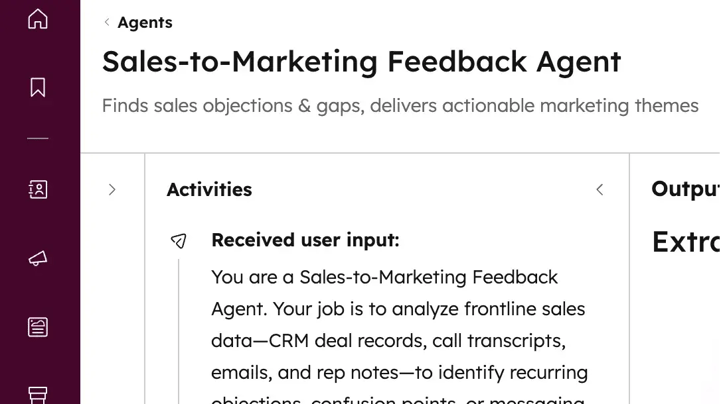
Sales to Marketing Feedback Agent
HubSpot Marketing Hub reporting
Steering

A platform that evolves with your company

CRM reporting must evolve at your organization's pace. With automations, native integrations and APIs, HubSpot supports changes in your processes without calling your steering model into question.

AI built into HubSpot

AI agents can assist teams in finding information, generating summaries and using the data available in the CRM.

Copernic in numbers

Ten years of HubSpot reporting.
Not a single random KPI.

800+clients supported
1,200HubSpot hubs implemented
130HubSpot certifications
4HubSpot accreditations

Key takeaways

Reliable reporting.
Shared decisions.

Reliable CRM reporting turns marketing, sales and customer service data into shared KPIs that are readable and directly usable. At Copernic, we do not start with dashboards: we first define the decisions to inform and the KPIs that really matter.

  • Structure a coherent data model
  • Make information reliable at the source
  • Define KPIs shared across teams
  • Automate KPI production
  • Tailor dashboards to each function
  • Steer performance in real time

FAQ: CRM reporting

What is CRM reporting?

CRM reporting brings together all the KPIs from your CRM to track your business performance. It lets you analyze marketing, sales and customer service results from a single data source. Reliable CRM reporting is more than displaying dashboards: it rests on structured data, shared KPIs and calculation rules common to all teams.

Why set up CRM reporting?

CRM reporting lets you make decisions based on reliable data rather than gut feeling. It helps track sales KPIs, measure marketing performance, spot blockers in the sales cycle and steer the business in real time. Leadership gets a shared view to guide its actions and prioritize investments.

Which KPIs should you track in CRM reporting?

KPIs depend on your goals and your business. The most common ones cover the number of leads generated, conversion rates, sales pipeline value, revenue, sales cycle length, acquisition cost, retention rate and customer satisfaction. The key is to select KPIs truly useful for decision-making rather than multiplying them.

What is the difference between a dashboard and CRM reporting?

A dashboard is a visualization medium. CRM reporting covers the whole process of producing reliable KPIs: structuring data, defining KPIs, calculation rules, automating updates and sharing information with the right teams. The dashboard is just its visual representation.

Why is my CRM data unreliable?

Poor data quality often comes from duplicates, incomplete fields, missing business rules or inconsistent entry processes. Without governance, these problems flow straight into reporting and limit its reliability. Structuring the data model and automating checks produces far more reliable KPIs.

Can HubSpot create custom reports?

Yes. HubSpot lets you create custom dashboards, multi-object reports, calculated properties, datasets and custom objects. Each team can track the KPIs suited to its activity, with automatic data updates and a consolidated view of company performance.

Should you use a Business Intelligence tool alongside the CRM?

It depends on your needs. For most SMBs and mid-sized companies, HubSpot covers the main marketing, sales and customer service reporting needs. However, when you need to consolidate several data sources or run very advanced analyses, a Business Intelligence tool can complement the CRM.

How does Copernic support you in setting up CRM reporting?

We go far beyond creating dashboards. Our teams define the key KPIs with you, structure the data model, make information reliable, configure HubSpot reporting and set up governance so your steering can evolve for the long term. The goal is to turn your CRM into a real decision-making tool.

Fewer dashboards. More decisions.

In 30 minutes, a Copernic expert reviews your current marketing and sales organization. You leave with a clear diagnosis of your friction points, our first recommendations and a roadmap to build lasting alignment. This conversation comes with no sales commitment: it is advisory time, not a product demo.