Centralize your data. Finally trust your CRM.

Copernic helps marketing, sales, customer service and executive leaders turn their CRM data into a reliable, usable and shared single source of reference. 

Talk to an expert See the case study
HubSpot Elite Partner
800+ clients supported
10+ years of HubSpot expertise
Challenges

Bad data is expensive.
Reliable data drives decisions.

Reliable CRM data directly improves campaign performance, sales productivity, service quality and leadership's ability to make trade-offs. It also cuts the hidden cost of manual reprocessing and of decisions made from contradictory KPIs.

business processes

Align teams around the same information

When marketing, sales and customer service use different sources, each team builds its own version of reality. A centralized database lets everyone share the same definitions, the same statuses and the same history.


What we see

The project cost is then justified by fewer checks, fewer manual exports and fewer debates about whether the numbers can be trusted.

data

Secure automations and customer journeys

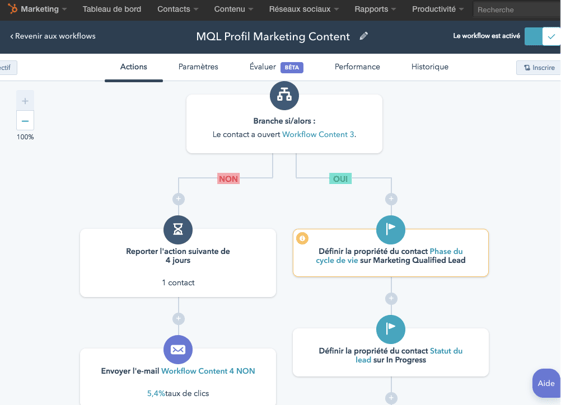
HubSpot workflows are only as reliable as their enrollment criteria. A poorly filled property can trigger the wrong email, assign a lead to the wrong rep or skew a score.


What we see

Data quality limits this risk and makes automations truly scalable, without piling up exceptions and manual fixes.

team alignment

Improve reporting accuracy

Accurate reporting rests on consistent data, coherent associations and documented calculation rules. Without them, teams spend more time reconciling numbers than interpreting them.


What we see

Making data reliable shortens the report production cycle and lets leadership make faster decisions with greater confidence.

CRM implementation

Prepare a migration or controlled growth

Growth increases volumes, integrations and usage. It also amplifies existing flaws. Making data reliable before a migration or a redesign avoids carrying historical debt into the new environment. 


What we see

The project can be gradual: priority rules are handled first, then expanded based on business value and risk level.

What is centralized, reliable CRM data?

Centralizing CRM data and making it reliable means gathering customer information in a shared repository, normalizing it, deduplicating it and guaranteeing its quality over time. As a HubSpot, CRM, Data and RevOps consulting firm, Copernic helps companies turn the CRM into a source of truth actually used by marketing, sales, customer service and leadership.

Reliable data is more than a clean database. It must be accurate, complete, up to date, correctly associated and understood by the people who use it. It must also serve a precise business goal: segmenting an audience, prioritizing an opportunity, personalizing a journey, measuring revenue or improving service quality.

Centralization reduces gaps between tools. Governance maintains quality. Business rules turn raw data into usable information. Without these three dimensions, the CRM remains just another warehouse rather than a steering system.

 CRM source of truth
 Data quality
 Deduplication
 Data governance
01

Data sources

ERP, legacy CRM, forms, files, billing tools and business platforms feed the system.

02

Quality rules

Data is normalized, deduplicated, associated and checked against shared governance rules.

03

CRM source of truth

HubSpot centralizes contacts, companies, deals, tickets and custom objects in a coherent model.

04

Shared steering

Teams use shared data to segment, automate, sell, serve customers and steer performance.

Goal: turn scattered data into a reliable source of truth that marketing, sales, customer service and leadership can use.

Your CRM has the data. Your routine has the answers.

A targeted audit identifies duplicates, unused properties, broken associations, sync errors and missing governance rules.

Our vision

Organization first.
Tools second.

Copernic approaches data centralization and reliability as an organization, process and governance project before it is a HubSpot project.

The tool must reflect clear business rules, deliver the right information to the right teams and secure decisions. Without this foundation, the CRM's most advanced features stay underused or produce inconsistent results.

Data governance workshop

Consulting helps choose what should become shared

Centralizing does not mean storing everything in one place. You need to decide which data must be shared, which stays in a specialized system and which is no longer worth keeping. This trade-off work involves business leaders, because the value of data depends on how it is used, not just on its technical availability.

HubSpot architecture and data model

Expertise turns rules into an operational system

Once the model is defined, we configure the objects, properties, associations, automations, permissions and reports that make these rules enforceable. Our HubSpot expertise avoids fragile workarounds and uses native features when they meet the need. Custom development is kept for cases where it brings clear, lasting value.

CRM data steering

Data makes quality measurable and manageable

Quality must translate into concrete KPIs: completeness, freshness, consistency, uniqueness and availability. These measures help prioritize actions and track progress objectively. They turn data into a managed asset rather than a one-off project triggered only when problems become visible.

Our method

Measure from day one.
Prove it over time.

Our method secures decisions, limits operational disruption and prepares teams to work on their own. Each stage produces concrete deliverables and shared acceptance criteria.

01

Understand · Think

Data and process audit

We analyze sources, volumes, business rules, usage, duplicates, properties, associations and integrations. The audit identifies the risks, priorities and decisions to make before any change to the CRM.

02

Model · Think

Target model design

We define the target objects, properties, identifiers, merge rules, responsibilities and flows. Trade-offs are documented so business, data and technical teams understand them.

03

Implement · Build

Cleanup, migration and rollout

We prepare the data, configure HubSpot, test transformations and run migrations or syncs in controlled batches. Business acceptance testing checks compliance before go-live.

04

Steer · Run

Adoption and ongoing governance

We train admins and users, deliver documentation and set up quality KPIs. Teams get the rules and habits they need to maintain the system.

Approach & method

Every tool has its version.
You keep just one.

Our approach combines business audit, data architecture, HubSpot expertise, governance and change management. These six dimensions are handled in parallel, because data quality depends as much on processes and responsibilities as on technical configuration.

Map sources and business uses

We list the tools, files, objects, flows and owners that produce or consume data. This mapping does not only aim to document what exists.

It links each piece of information to a concrete use:

  • prospecting,
  • segmentation,
  • sales,
  • billing,
  • support,
  • retention
  • reporting.

This identifies the data that is truly useful and the redundancies that keep complexity alive.

Our recommendation: do not start by deleting properties. First understand who uses them, in which process and with what level of reliability.

Define an understandable data model

We structure HubSpot objects, their properties and associations around the company's real processes. The model specifies what belongs to the contact, the company, the deal, the ticket or a custom object.

It also clarifies:

  • unique identifiers,
  • required fields,
  • allowed values
  • dependencies between data, to avoid competing interpretations.

Our recommendation: a simple but coherent data model beats an exhaustive architecture nobody knows how to maintain.

Clean, normalize and deduplicate

We apply cleanup rules suited to volumes and risks:

  • phone formats,
  • countries,
  • salutations,
  • domains,
  • statuses,
  • duplicates and orphan records.

Merges are prepared with priority rules to keep useful history, the right associations and the most recent data. Deduplication becomes a controlled process rather than a mass deletion.

Our recommendation: never launch a mass cleanup without identifying the master record and the impact on history, workflows and integrations.

Make integrations and syncs reliable

Data errors often come from poorly defined flows between HubSpot and an ERP, a billing tool, a product platform or a support system.

We document:

  • sync direction,
  • frequency,
  • priority rules,
  • transformations and failure cases.

Each flow has a clear scope and a control mechanism to limit conflicting updates.

Our recommendation: assign a master system to each critical piece of data. Blanket two-way sync creates more conflicts than it solves.

Set up lasting governance

We define the roles, permissions and business rules needed to maintain quality over time.

Governance specifies who can:

  • create a property,
  • edit a value,
  • merge a duplicate,
  • change a status, 
  • fix an error.

It relies on accessible documentation, regular reviews and quality KPIs shared with operational teams.

Our recommendation: build governance into existing rituals. A monthly review of a few KPIs works better than one big annual cleanup.

Measure and improve quality continuously

We set up dashboards on:

  • completeness,
  • duplicates,
  • freshness,
  • sync errors,
  • records without associations,
  • unused properties.

These KPIs help rank actions by impact. Teams can then track quality over time, detect regressions and adjust rules before they degrade processes.

Our recommendation: data quality is not an end state. It is an operational capability that must be steered like any other performance KPI.

Camille, HubSpot project manager at Copernic
Fewer screens.
More decisions.
Camille · HubSpot project manager
Case study

How Homunity turned a CRM migration into a data quality project

Homunity had to migrate a large volume of data while simplifying a CRM that had become too complex. Copernic used the migration as an opportunity to make the data reliable, streamline the model and set up a single contact logic.

 
Homunity logo in white
 

A HubSpot migration to rebuild a reliable CRM database

With nearly 194,000 contacts, 141,000 companies, 470,000 deals and 193,000 notes, Homunity was facing a CRM database that had become hard to maintain. The migration from Salesforce to HubSpot was not just a tool change: it was a chance to clear accumulated data debt and rebuild a lasting source of truth.

Real estate investment CRM migration Data quality

A successful migration always starts with the data.

Context

The company's growth had gradually made the CRM more complex. Duplicates, incomplete contacts, unlinked companies and obsolete properties made steering harder and harder.

Challenge

Migrate to HubSpot without carrying over Salesforce's historical flaws. The goal was to centralize data, simplify the CRM model and keep all history within less than three months.

Intervention

Copernic prepared the migration rules, adopted a single contact model, cleaned the data and streamlined properties. On some objects, the number of properties was cut by up to 90%.

Result

The migration was wrapped up in under three months, with the main history carried over. Julien Béril, Head of Product, describes it as “a tour de force in under 3 months”.

See the Homunity case study →

What clients say

Their databases were complex.
Their teams are autonomous.

Deduplicating the database

“Thanks to Charline for the quality work delivered, despite the somewhat complex way our different databases work, and for her availability.”
N. GarcinWIISMILE · B2B services

Autonomous on our data

“I can finally take ownership of this CRM to align our teams on healthy, efficient usage. They understand our challenges very quickly and help us become autonomous in managing our data in HubSpot.”
D. ClainBIM AND CO · Construction

Many data sources

“On a complex, ambitious project bringing together many teams and many data sources, Baptiste and Camille translated user needs into features through very thorough and very effective scoping workshops.”
C. LapicheLa Villette · Culture

Scroll →

Reviews translated from French.

Artificial intelligence

AI fixes the data.
Your teams put it to work.

Artificial intelligence does not replace data governance. It does, however, considerably speed up checking, cleanup, enrichment and analysis tasks. Properly built into the CRM, it lets teams spend less time fixing data and more time using it.

AI for marketing production
01

Detect anomalies automatically

AI identifies incomplete records, entry inconsistencies, outliers and potential duplicates before they degrade campaigns, reporting or automations.

02

Enrich CRM data

AI agents can fill in certain information, suggest categorization, summarize sales conversations or automatically retrieve useful information from conversations, emails or calls.

03

Improve reporting quality

By detecting missing or inconsistent data, AI makes dashboards more reliable and delivers more relevant analysis for marketing, sales and executive leaders.

04

Assist CRM admins

AI can suggest property optimizations, identify workflows that are no longer needed or spot underused objects to keep the CRM simpler and more sustainable.

HubSpot

A clean database does not stay clean on its own.
HubSpot checks it every day.

HubSpot provides several building blocks to structure, check and use data. Their effectiveness, however, depends on the governance model, business rules and maintenance discipline defined upfront.

Data governance

Build a reliable source of truth

Reliable data starts with a structured data model. HubSpot lets you organize your objects, properties and their relationships so every team works from shared, consistent, usable information.

HubSpot AI

Breeze can identify inconsistencies in your data, suggest enrichments and help teams keep a more reliable CRM database.

HubSpot CRM governance
HubSpot data quality
Data quality

Control your CRM quality

HubSpot makes it easier to identify incomplete, inconsistent or duplicate data, to preserve your CRM's reliability and limit errors in your campaigns, reporting and automations.

HubSpot AI

AI helps detect anomalies, suggests fixes and makes ongoing CRM database cleanup easier.

Automation

Keep a reliable database over time

Data quality does not rest on a one-off cleanup alone. HubSpot automations apply shared rules, limit entry errors and keep the CRM consistent over time.

HubSpot AI

Breeze can automatically fill certain properties from emails, calls or conversations to reduce manual entry.

HubSpot workflows
HubSpot reporting
Reporting & integrations

Use reliable data to steer better

HubSpot centralizes data from your different tools to produce consistent reporting and guarantee a reliable view of your business.

HubSpot AI

AI speeds up CRM data analysis, brings out important trends and helps teams produce reports faster.

Copernic in numbers

Our numbers can be checked.
Yours will be too.

800+clients supported
1,200HubSpot hubs implemented
130HubSpot certifications
4HubSpot accreditations

Key takeaways

One source of truth.
Reliable data over time.

Centralizing your CRM data means bringing together information from the company's different tools in a single repository, then normalizing, deduplicating, governing and keeping it up to date. At Copernic, data quality is an organizational challenge before it is a technical one.

  • Centralize data from the CRM, ERP, forms and business applications
  • Normalize properties, formats and reference data
  • Deduplicate contacts, companies and deals using documented rules
  • Govern data: responsibilities, entry rules, quality checks
  • Make syncs between HubSpot and other systems reliable
  • Make the CRM a source of truth for reporting and decisions

FAQ: CRM data quality

What is reliable CRM data?

Reliable CRM data is complete, accurate, normalized, deduplicated, up to date and usable by teams. It must also be tied to a shared definition, an owner and an identified business use. Data can be technically present yet unusable if its meaning varies between teams or if nobody knows when it should be updated. 

How do you make HubSpot a CRM source of truth?

HubSpot becomes a source of truth when objects, properties, sync rules, edit permissions and control processes are defined before configuration. You also need to assign a master system to critical data, document calculation rules and check associations between objects. The source of truth is therefore not just a central tool: it is a governed repository. 

When should you launch a CRM data quality project?

The project becomes a priority when teams no longer trust the CRM, duplicates multiply, reports diverge or a migration is planned. Other signals exist: unstable automations, frequent manual searches, unused properties, records without a company or recurring errors between the CRM and the ERP. Acting before a migration greatly reduces the risk of carrying over existing debt. 

How long does it take to clean up a CRM and make it reliable?

Duration depends on volume, number of sources, initial quality and the governance decisions to make. A targeted audit can be run in a few weeks. A full overhaul, including cleanup, migration, integrations and adoption, usually spans several months. The timeline depends mostly on how fast business decisions are made and how available teams are for acceptance testing. 

Should you delete all CRM duplicates?

No, duplicates must be merged or deleted according to explicit priority rules. You need to identify the master record, the values to keep, the associations to carry over and the effects on history. Some apparent duplicates are actually different people or companies. An uncontrolled mass operation can delete activities, skew reports or break automations. 

How do you stop data errors from coming back?

Lasting quality rests on entry rules, automated checks, clear responsibilities and KPIs tracked over time. You also need to limit property creation, supervise imports, monitor integrations and train users. A one-off cleanup is not enough when the processes causing the errors stay unchanged. 

Which KPIs should you track to steer CRM data quality?

The main KPIs are completeness rate, duplicate rate, freshness, orphan records and sync errors. It is also useful to measure the share of unused properties, values outside reference lists, missing associations and the volume of manual fixes. These KPIs must be tied to business goals to avoid purely technical steering. 

Why work with a HubSpot consulting firm?

A HubSpot consulting firm brings an independent view of processes, CRM architecture, data and usage. It does not just configure the tool. It helps make trade-offs, document, test and secure transformations. Support reduces migration risks, speeds up decisions and builds a system that fits the organization rather than a pile of features. 

Every morning, what matters. The rest can wait.

Copernic supports companies that want to centralize, clean, migrate or govern their data in HubSpot. Our team combines consulting, CRM, data and RevOps expertise to secure decisions and make the system last. 800+ clients have already been supported by our HubSpot-certified consultants. Let's start with a focused conversation about your sources, pain points and priorities.