Roll out a CRM AI that creates real value
We help companies bring artificial intelligence into the heart of their CRM to automate processes, assist teams and improve the quality of decisions, with a pragmatic, governed and business-driven approach.
Turning AI on is easy.
Making it pay off is not.
Rolling out artificial intelligence in a CRM is not about switching on a few features. It is a transformation project that combines data, processes, automation and change management. Our expertise covers every dimension needed to turn the CRM into a truly intelligent system, one that assists teams, gains efficiency and improves the quality of decisions.
Design an AI roadmap aligned with your business goals
Not every organization has the same priorities. We identify the use cases that create the most value, assess their feasibility and build a step-by-step roadmap. This approach focuses investment on the uses that genuinely improve sales, marketing or customer service performance, instead of piling up experiments with no overall vision.
What we see
Companies often start with the tools, when success depends first on a clear view of the uses.

Turn your CRM into a platform that assists your teams.
We bring artificial intelligence directly into the heart of your CRM to enrich data automatically, qualify opportunities, recommend next actions and personalize interactions. The goal is to make the CRM a tool that supports employees in their daily decisions, not just a data repository.
What we see
In many companies, the CRM stores information. It still rarely helps make decisions.

Automate complex processes with intelligent agents.
Beyond traditional workflows, we design advanced automations and AI agents that can analyze a context, reason and carry out actions within the CRM. These new uses speed up processing, cut repetitive tasks and refocus teams on high-value work.
What we see
Most automations execute rules. AI agents now carry out missions.

Roll out artificial intelligence that is reliable, controlled and lasting.
The effectiveness of a CRM AI rests on data quality, governance and team adoption. We structure usage rules, define responsibilities, support users and set up the indicators needed to measure the performance of AI uses over time.
What we see
The best-performing AI projects are the ones where the organization evolves as much as the technology.
What really turns a CRM into a CRM AI?
A CRM AI is a customer relationship management system that uses artificial intelligence to understand context, recommend the best actions, automate processes and assist users in their daily work. The goal is not to replace teams, but to help them make better decisions, faster, through smart use of CRM data.
A CRM AI is not just a chatbot, a writing assistant or a string of workflows. Its real value lies in its ability to connect artificial intelligence to company data, business processes and everyday tools in order to carry out actions that are relevant, contextual and measurable.
This expertise draws on several complementary disciplines: data governance, advanced automation, generative AI, predictive models, AI agents and CRM integration. At Copernic, we design these building blocks as a consistent ecosystem that can evolve with your organization and your growth goals.
Is your CRM ready for AI? Let's check together.
AI only creates value when it rests on reliable data, controlled processes and clearly defined uses. Let's talk about your project and identify the most relevant opportunities.
Artificial intelligence does not replace a CRM strategy.
It makes it perform better.
Artificial intelligence is changing the way companies use their CRM. Yet technology alone guarantees neither better results nor better adoption. To create lasting value, it must rest on a clear strategy, controlled data and consistent integration with business processes. This end-to-end approach guides every one of our engagements.
Align AI with your strategy
Goal: define an artificial intelligence strategy aligned with your business goals, your processes and your level of maturity.
What we do: we identify the most relevant use cases, prioritize investments and build a realistic roadmap before any technical decision.
Our conviction: without a business vision, artificial intelligence speeds up processes… but not necessarily the right ones.
Structure usable data
Goal: build data that is reliable, governed and usable by predictive models, AI agents and advanced automations.
What we do: we structure your data model, improve its quality and define the governance rules that keep recommendations relevant over time.
Our conviction: high-performing AI always starts with a reliable CRM. Bad data simply produces a bad decision… faster.
Build AI into your processes
Goal: bring artificial intelligence directly into the tools your teams use every day.
What we do: we roll out HubSpot's AI features, build advanced automations, integrate AI agents and connect your CRM to your application ecosystem.
Our conviction: the best artificial intelligence is the kind that fits naturally into existing processes, without adding a new tool to learn.
One use case first.
The whole team next.
Understand · Think
Understand your challenges
We analyze your goals, your organization and your processes to identify the uses of artificial intelligence that create the most value.
Model · Think
Design the approach
We define the use cases, CRM architecture, automations, AI agents and governance rules suited to your organization.
Implement · Build
Roll out step by step
We integrate the data, support the teams and validate each use before rolling it out at scale.
Steer · Run
Optimize continuously
We track performance, evolve the uses and adapt your AI strategy as you grow.
Data, uses, adoption.
AI stands on all three.
Rolling out artificial intelligence in a CRM is not about switching on one more feature. It is a transformation project that must answer specific business challenges, rest on reliable data and fit naturally into the way teams work. Our method lets us design concrete uses, roll them out step by step and measure their impact on company performance.
Understand your business challenges
We start by analyzing your organization, your processes and your goals to identify where artificial intelligence can add the most value. This step separates truly strategic uses from passing trends.
Our recommendation: focus on a few high-impact use cases before scaling AI.
Assess your CRM's maturity
Before bringing in AI, we audit data quality, existing processes, automations and integrations. This analysis secures future uses and prevents AI from reproducing or amplifying existing dysfunctions.
Our recommendation: build AI on a reliable CRM rather than fixing problems after rollout.
Design the use case
We define the scenarios that will bring your teams the most value: smart lead qualification, automatic enrichment, meeting preparation, sales assistance, marketing personalization, customer support or predictive steering.
Our recommendation: design the uses before choosing the technologies that will run them.
Roll out automations and AI agents
We integrate advanced automations, predictive models and AI agents directly into your CRM environment. Each automation is designed to work alongside teams, cut repetitive tasks and speed up business processes.
Our recommendation: automate repetitive tasks, never human judgment.
Keep data reliable at all times
Artificial intelligence depends directly on the quality of the information it uses. We set up the mechanisms needed to enrich, standardize, deduplicate and maintain your CRM data so recommendations stay relevant over time.
Our recommendation: treat data quality as an ongoing project.
Support the teams
Adoption remains the main success factor of an AI project. We support users, adapt processes and define best practices so artificial intelligence is seen as everyday help rather than one more constraint.
Our recommendation: evolve the uses as much as the technologies.
Steer and evolve the uses
AI moves fast. We track adoption indicators, analyze the performance of the use cases rolled out and evolve models, agents and automations so they keep creating value over time.
Our recommendation: treat AI as a continuous improvement effort.
Eight deliverables.
Your teams know what to do on Monday.
Deliverables that business leaders, CRM teams and integrators can use right away.
CRM AI
audit
Assessment of your CRM's AI maturity.
Use case map
Uses prioritized by business value.
AI
roadmap
A step-by-step, realistic rollout schedule.
Target
architecture
Organization of data, tools and integrations.
Functional specifications
Documentation of automations and AI agents.
AI
governance
Usage rules, responsibilities and controls.
Support
plan
Team training and adoption.
Performance steering
Tracking and continuous improvement indicators.
A CRM migration: the chance to bring the sales organization up to standard
Behind a change of tool there is often a real structuring project. Here is how this scoping turned into concrete results.
Move from Salesforce to HubSpot without losing sales momentum.
A CRM migration that became the chance to make data reliable and get the sales team back in working order from week one, with no break in activity.

The CRM as an accelerator of sales autonomy.
A finance team on Salesforce that needed to regain control fast, with no break in activity.
Avoid any loss of sales velocity during the switchover and guarantee immediate adoption.
Full data migration, configuration of the HubSpot ecosystem and close support for the teams.
100% of users active in 7 days, and twice as much time saved on prospecting.
What clients say
Understand before you automate.
They lived it.
Groundwork for growth
“The work done has been very structuring for the future and will allow us to enter a growth phase.”
Our business model, quickly understood
“A structured, targeted approach, with a quick and accurate grasp of our business model as well as our specific needs.”
Rigor that serves the result
“I really appreciate the rigor Copernic applies to itself to reach the best result.”
Reviews translated from French · Scroll →
Automate the tasks.
Never the judgment.
AI no longer just writes.
It predicts, qualifies and acts.
Artificial intelligence is profoundly changing how the CRM is used. It no longer stops at generating content or answering questions: it can now enrich data, predict opportunities, automate decisions and assist teams in their daily work. At Copernic, we design these uses as performance levers, always built into your CRM, your processes and your governance.
Conversational AI
Conversational AI supports employees in their daily tasks by generating content, summarizing exchanges, finding relevant information or preparing meetings. It saves time while improving the quality and consistency of interactions with prospects and customers.
Predictive AI
Using CRM data and behavioral signals, AI can identify the most promising prospects, detect buying intent, recommend next sales actions or estimate conversion probabilities. Teams can then focus their efforts on the highest-value opportunities.
AI agents
AI agents go further than traditional workflows. They analyze a context, make decisions according to defined rules and carry out several actions on their own. They can qualify a prospect, enrich a CRM record, handle a customer request or assist teams in running complex processes.
AI governance
The effectiveness of an AI project depends above all on the quality of the data, the governance and the processes around it. We define the usage rules, control mechanisms and performance indicators needed for uses that are reliable, secure and scalable. Our goal is to make artificial intelligence a lasting performance lever, not an isolated experiment.
The AI building blocks exist.
They still need tuning.
HubSpot natively includes many artificial intelligence capabilities that improve data quality, automate processes and assist marketing, sales and customer service teams. As a HubSpot Elite Partner, we help you select, configure and roll out the most relevant features for your maturity level and goals.
Enrich your customer knowledge automatically
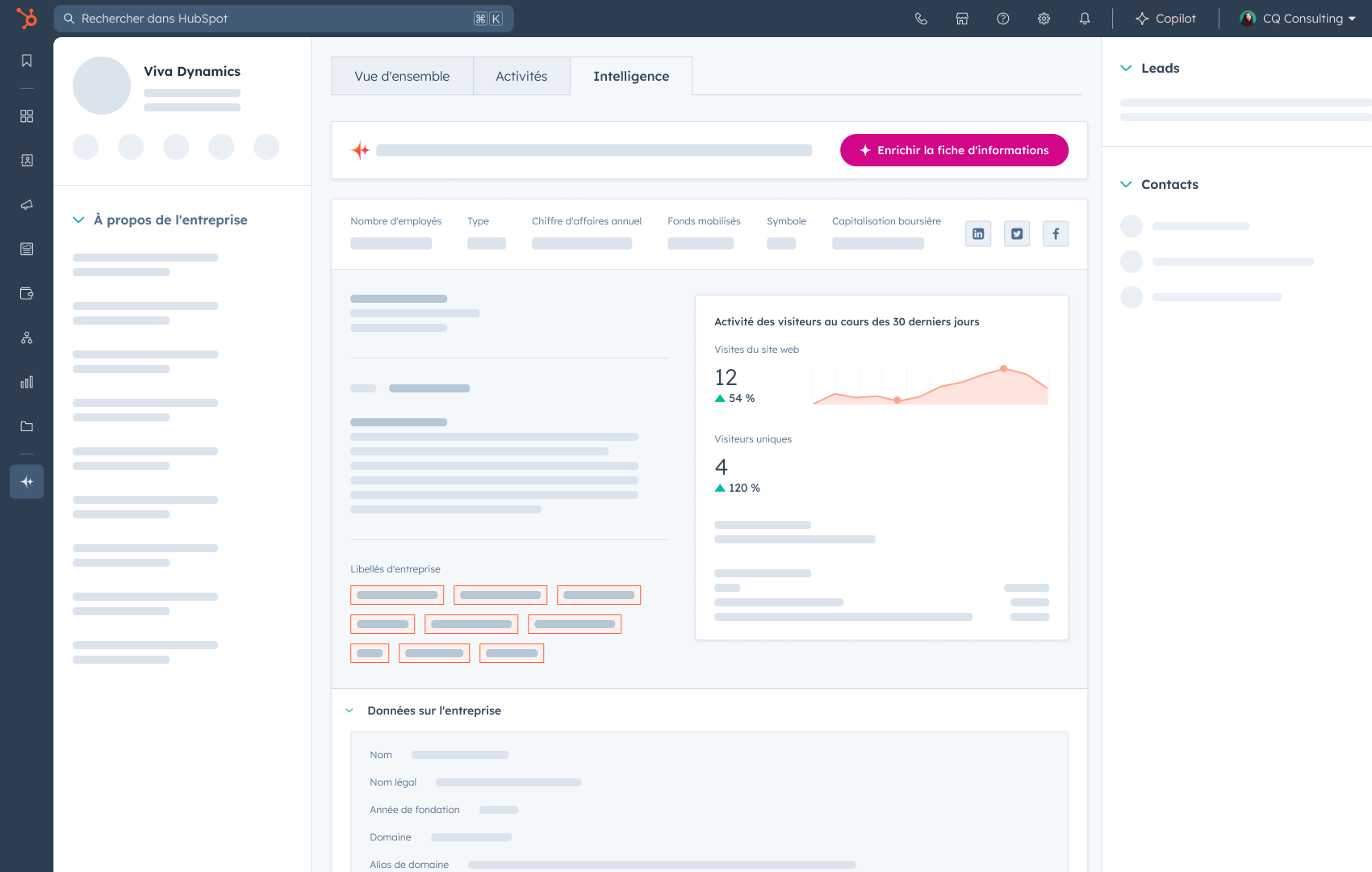
With Breeze Intelligence and data quality tools, HubSpot completes information on contacts and companies, detects some inconsistencies and improves the context available in the CRM. This data can then feed segmentation, scores, automations and the recommendations offered to teams.
Our view
Enriching a database without defining how the new data will be used increases its volume, not necessarily its value.
Focus teams on the best opportunities
HubSpot analyzes CRM data, digital behavior and intent signals to help teams identify which contacts and companies to handle first. Predictive scoring and Buyer Intent complement business criteria to improve qualification and guide sales actions at the right moment.
Our view
A score does not improve performance on its own. It must trigger a clear action that teams understand and follow through on.
Give every team an assistant built into the CRM
HubSpot's AI assistants make it easier to prepare meetings, summarize exchanges, find information and create content. Because it stays within the CRM context, artificial intelligence reduces admin work and helps employees act faster without multiplying tools or losing control of their decisions.
our view
The right use of AI is not to produce more, but to free up time for tasks that require expertise and judgment.
Hand specific missions to AI agents
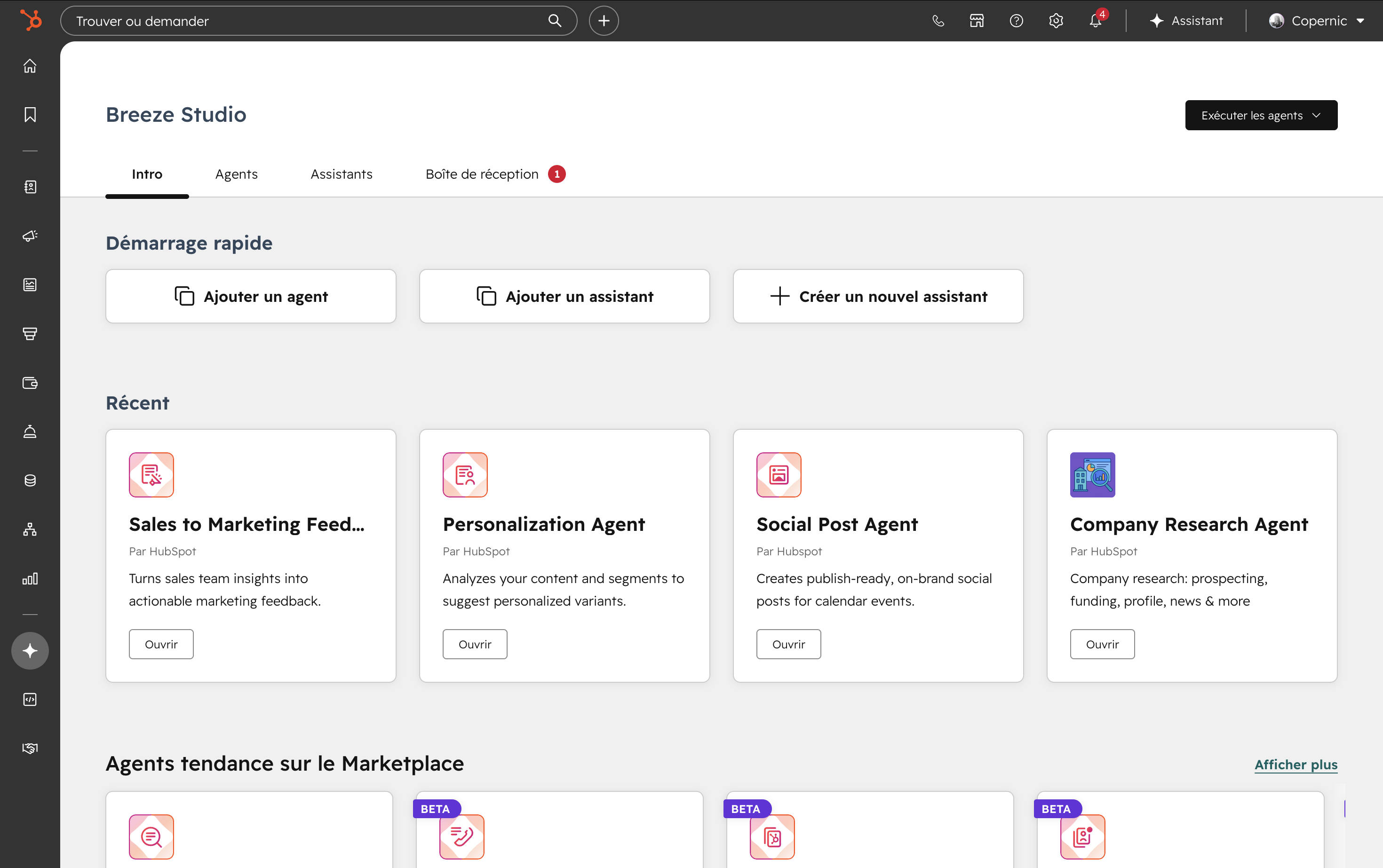
HubSpot agents can use CRM data, company content and business rules to answer requests, qualify a need or carry out certain actions. We define their role, their scope and their escalation conditions so they complement teams without creating opaque or uncontrolled journeys.
our view
An effective agent does not need to do everything. It must carry out a clearly defined mission, with explicit limits and handoffs.
AI is new.
Our HubSpot expertise is not.
Copernic is a HubSpot Elite Partner and has supported HubSpot projects for 10+ years. Our work covers the whole project: from identifying use cases to rolling out HubSpot's AI features, advanced automations, AI agents, data governance and continuous improvement of uses.
Key takeaway
Uses first.
Technology second.
Artificial intelligence applied to CRM means using data, processes and customer interactions to automate tasks, assist teams and improve decisions. A CRM AI is more than a conversational assistant: it combines generative AI, predictive models, autonomous agents and advanced automations to lift sales, marketing and customer service performance for the long run.
We don't start by rolling out an AI agent or switching on a feature. We start by identifying the uses that will create real value, then design a CRM architecture that can evolve them over time.
- Make the data that feeds AI reliable
- Prioritize high-impact use cases
- Design agents that are genuinely useful
- Automate business processes
- Support team adoption
- Steer performance continuously
FAQ: CRM & artificial intelligence
What is the difference between a CRM AI and a standard CRM?
A CRM AI includes artificial intelligence capabilities to assist teams, automate certain tasks and improve decision-making based on CRM data.
How much does a CRM AI project cost?
The budget depends on your CRM's maturity, the use cases to roll out and the integrations required. Every project starts with a scoping phase.
How long does it take to roll out a CRM AI?
The timeline depends on the project scope. The first use cases can usually be rolled out in a few weeks, before a gradual ramp-up.
What results can we expect?
The benefits mainly concern time savings, better data quality, opportunity prioritization, process automation and support for teams in their decisions.
Do you need a perfectly structured CRM before bringing in artificial intelligence?
Not necessarily. A perfectly structured CRM is not a prerequisite, but data quality directly drives the performance of artificial intelligence. That is why we always start by assessing your CRM's maturity, identifying blockers and defining priority improvements before rolling out the first use cases.
Which use cases deliver the best return on investment?
It depends on your business challenges. For some companies, the main lever will be automatic data enrichment or predictive scoring. For others, the gains will come more from AI agents, process automation or assistance for sales and customer service teams. Our role is to identify the uses that create the most value for your organization.
Does artificial intelligence replace marketing, sales or support teams?
No. Artificial intelligence mainly automates repetitive tasks, makes information easier to access and supports decision-making. Employees keep responsibility for trade-offs, high-value conversations and customer relationships. We design AI as an assistance tool, never as a substitute for human expertise.
Who should take part in a CRM AI project?
A CRM AI project is first and foremost a company project. Marketing, sales, customer service, CRM, RevOps, data and IT leaders must be involved from the first phases to align goals, processes and data governance. This approach ensures better adoption and uses that are truly built into how the company works.
What does your support include?
Our work covers the whole project. We support you from identifying use cases to rolling out HubSpot features, advanced automations, AI agents, data governance, change management and continuous improvement of uses. The goal is to build an intelligent CRM that is lasting and scalable.
Can Copernic step in before a tool, or HubSpot, is chosen?
Yes. Our role is first to help you define your strategy for artificial intelligence applied to CRM, regardless of the technology chosen. If HubSpot meets your needs, we then support you with its integration, configuration and the rollout of the most relevant AI uses.
AI is paid by usage. The return must be proven.
Artificial intelligence only creates value when it rests on a clear strategy, reliable data and controlled processes. Let's talk about your challenges and build a roadmap suited to your organization and your ambitions.