Track MRR, churn and expansion in one CRM

MRR, churn and renewals tracked in three different tools? Copernic builds HubSpot around your subscription model.

Talk to an expert Download the CRM requirements template (in French)
HubSpot Elite Partner
800+ clients supported
10+ years of HubSpot expertise
Your challenges

SaaS is won at renewal.
Not at signature.

SaaS growth runs on one unbroken chain: acquisition, conversion, adoption and retention. When one link is poorly structured or data flows badly, your CRM loses part of its value.

Copernic expert auditing HubSpot data
01. Acquisition

Your CAC rises while pipeline quality stands still

More leads only matter if that spend creates profitable customers. We structure ICP, qualification, scoring, attribution and intent signals to tie your marketing spend to pipeline and to the revenue it actually generates.


Observable signal

You know your cost per lead, but you still struggle to compare channels on CAC, ARR generated or the value of the customers acquired.

HubSpot workflow expert
02. New Business

Your pipeline gives no reliable view of new ARR

To steer growth, teams must tell apart opportunity volume, potential revenue and revenue actually won. Qualification, sales stages, recurring amounts and forecast must all follow the same rules.


Observable signal

Your leadership has to rework CRM data in Excel to know new ARR signed, win rate or the real length of the sales cycle.

Consultant auditing CRM processes
03. Churn & retention

You suffer churn instead of anticipating it

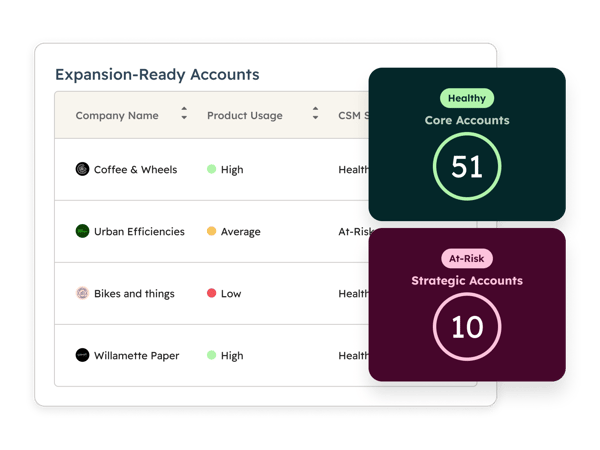
Product usage, satisfaction, tickets, interactions and contract data must reveal the accounts whose renewal odds are slipping before the due date.


Observable signal

Churn risk rests mostly on the CSM's gut feeling, or only shows up a few weeks before renewal.

Copernic consultant in HubSpot CRM architecture
04. Expansion

Your upsell opportunities lack structure

A software company does not grow on New Business alone. Renewals, upsell, cross-sell and contractions must be structured to grow existing revenue and lift Net Revenue Retention.


Observable signal

Upsell opportunities live in spreadsheets, or are only triggered at renewal.

Copernic experts in HubSpot adoption
05. Steering

Do MRR, ARR, NRR, CAC and LTV tell the same story?

CRM, product and billing each hold a piece of revenue. Reconciling them is essential to build reliable metrics and show leadership what really drives growth.


Observable signal

Marketing, Sales, Customer Success and Finance each have their own numbers and must reconcile them by hand, again and again.

SaaS CRM

What is a CRM for a SaaS software company?

A CRM for a SaaS software company is a system that tracks the entire revenue cycle: acquisition, conversion, onboarding, adoption, renewal, expansion and churn.

It goes beyond managing prospects and opportunities. It brings together the data Marketing, Sales and Customer Success need, and separates sold revenue, active revenue and revenue movements: New Business, expansion, contraction, renewal and churn.

The CRM does not replace your product or your billing tool. On the contrary, it must stay connected to the product, billing and business tools to surface the signals that matter: activation, usage, tickets, contract due dates.

  Acquisition & New Business
  Onboarding & adoption
  Renewal & expansion
  Product, billing & data

Your MRR is growing. Your churn too?

In 30 minutes, we review your organisation, your processes and your stack to pinpoint the main friction points and the HubSpot priorities to tackle.

Industry expertise

Your model is recurring.
So are your metrics.

The HubSpot Software Industry Specialist badge recognises partners able to support tech companies and software vendors on the issues specific to their model: acquisition, recurring revenue, Customer Success, integrations, product data and customer lifecycle steering.

At Copernic, this industry expertise adds to our command of HubSpot. We do not bend your business to fit the tool: we build HubSpot around your growth model, your teams and your information system.

MRR optimisation Churn reduction Product-led growth

Our services

From first trial to renewal.
One revenue cycle.

We work on the building blocks that truly drive your growth: CRM model, HubSpot, Customer Success, data, migration and adoption.

Structure your revenue cycle end to end

SaaS growth does not stop at acquisition or at the sale. In HubSpot, we build one shared model linking acquisition, New Business, activation, retention and expansion. Lifecycle, pipelines, ownership, handoff rules and metrics are defined so Marketing, Sales and Customer Success all work around the same revenue cycle.

What we see: in many SaaS companies, each team optimises its own part of the journey without a shared definition of the customer, the stages and revenue. The CRM ends up mirroring how teams are organised rather than the customer's real lifecycle.

Revenue cycle
Team alignment
Steering

Make HubSpot your teams' operating foundation

We configure and optimise HubSpot to translate your business processes into one shared environment: qualification, sales pipeline, automation, customer onboarding, support, renewals and reporting. The goal is not to use more features, but to make HubSpot truly usable by every team.

What we see: the most complex HubSpot portals are not necessarily the best performing. Piling up properties, workflows and pipelines without governance often ends up slowing teams down and weakening data.


Turn subscriptions into lasting adoption

We structure the Sales to Customer Success handoff, onboarding journeys, activation milestones, usage signals, satisfaction and renewals. Teams get the context they need to speed up time-to-value, spot at-risk accounts and grow retention.

What we see: churn becomes hard to anticipate when sales data, support interactions and usage signals stay apart. Customer Success must be able to understand an account's situation without rebuilding its history from several tools.

Adoption
Retention
Expansion

Connect HubSpot to your product and your SaaS stack

We define the data that must flow between HubSpot, your product, your billing system, your support tools and your data environment. Sources of truth, syncs, associations and governance rules are designed to put the right information in the right place.

What we see: trying to centralise all data in HubSpot is rarely the right strategy. The priority is to identify the data you need to segment, automate, prioritise or trigger an action in the CRM.

Product data
Billing
Synchronisation

Change CRM without carrying over old debt

We handle migrations from Salesforce, Pipedrive or legacy CRM environments by working on the target model first. Objects, properties, associations, history, automation and data are analysed before they move into HubSpot.

What we see: a like-for-like migration often carries the old CRM's accumulated problems into HubSpot. Use the migration to simplify the model and drop what no longer adds value.

Target model
Data migration
Data reliability

Change how teams work, not just the CRM

We support teams according to their role and level of responsibility. Users learn to run their day-to-day work in HubSpot, while managers get the methods and dashboards they need to steer their activity.

What we see: training delivered only at the end of a project is not enough. Adoption is prepared from the design phase, by involving future users in the processes and cutting needless manual work.

Training
Usage
Management
Camille, HubSpot Project Manager at Copernic
Every contract has a due date.
Every due date, a plan.
Camille · HubSpot Project Manager

What clients say

Their revenue cycle is clear.
Their teams say so.

Our business translated into HubSpot

“A team with strong business and product expertise that helped us translate our business challenges into HubSpot. The end result: better processes and a reinvigorated in-house team.”
G. CharonnatkShuttle · Software and SaaS

A complete onboarding

“A complete onboarding process, delivered with professionalism, attentiveness, empathy and proactive ideas.”
F. Aubigny LabordeGAIA · Software and SaaS

A well-run CRM migration

“It was a pleasure to work with Mark on the CRM migration. We really appreciated his flexibility, his capacity for work and his commitment.”
E. SandrinVyntra · Software and SaaS

Scroll →

Reviews translated from French

Artificial intelligence

AI sums up every account.
Your CSMs act sooner.

In a SaaS company, teams handle a growing volume of information: CRM data, sales conversations, tickets, usage data, documentation and customer history. The point of AI is not simply to automate more, but to make that information usable faster to understand a situation, prepare a decision and speed up some low-value tasks.

AI in marketing production
01

Sum up a customer context that has grown complex

One account can pile up several opportunities, subscriptions, contacts, tickets and interactions with your teams. AI can analyse this information to surface what matters faster, so teams no longer rebuild the history by hand before each interaction.

02

Spend less time on low-value tasks

Meeting notes, information searches, email drafting and call summaries take up a large share of team time. AI can take on or speed up these tasks, so sales reps and Customer Success spend more time on the relationship, analysis and decision-making.

03

Surface important information faster

As the customer base and data volume grow, spotting every meaningful change by hand gets hard. AI can help analyse available data and interactions to flag trends, anomalies or changes that deserve a human look.

04

Make information accessible to every team

A SaaS company's knowledge is often spread across the CRM, documentation, customer exchanges and various internal tools. AI assistants and agents make it easier to query these sources to find information, understand an account or get a first answer without always relying on an in-house expert.

HubSpot

Your product, your billing, your teams.
One platform.

HubSpot brings acquisition, sales, Customer Success and customer data together in one environment. Connected to your product and your billing tools, the platform can cover the whole revenue cycle, from identifying an account through to renewal and expansion.

01. Acquisition & qualification

Qualify and convert the right accounts

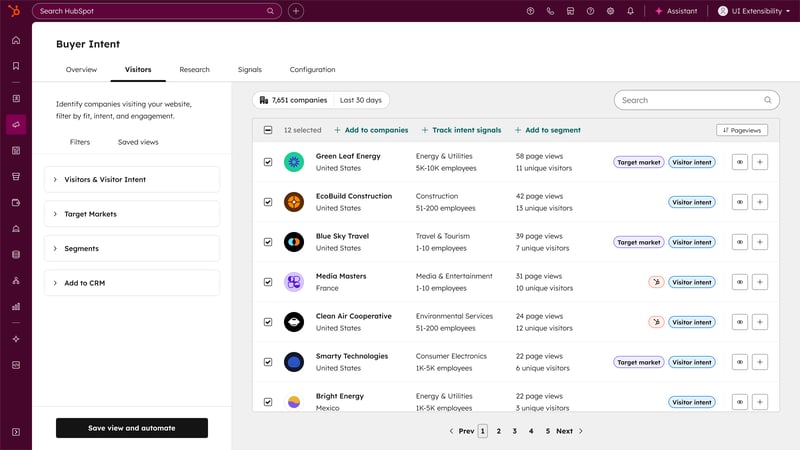
For B2B SaaS, not every lead has the same potential. HubSpot combines account characteristics, engagement and intent signals so teams focus on the most relevant companies.

HubSpot AI

Breeze enriches the context available on prospects and helps teams use the signals already in the CRM.

HubSpot buyer intent
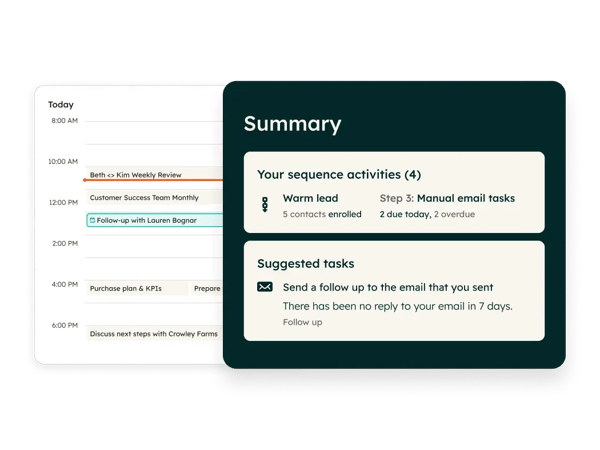
Sales Hub HubSpot - Sales Workspace Home
02. Sales

Structure and accelerate New Business

HubSpot formalises qualification and sales stages, automates repetitive actions and gives teams a shared view of the pipeline. Managers get more reliable steering of conversion and forecast.

HubSpot AI

AI features and agents can use sales interactions, summarise conversations and help reps prepare their next actions.

03. Customer Success

Steer adoption, retention and expansion

In SaaS, the relationship goes on after the subscription. HubSpot structures onboarding, centralises customer interactions and brings CRM data together with the signals needed to track adoption, renewals and expansion opportunities.

HubSpot AI

AI can help sum up customer context and surface faster the information CSMs need to plan their actions.

Service Hub HubSpot Customer Success workspace
Smart CRM HubSpot - tool integrations
04. Data & integrations

Connect HubSpot to your product and your revenue model

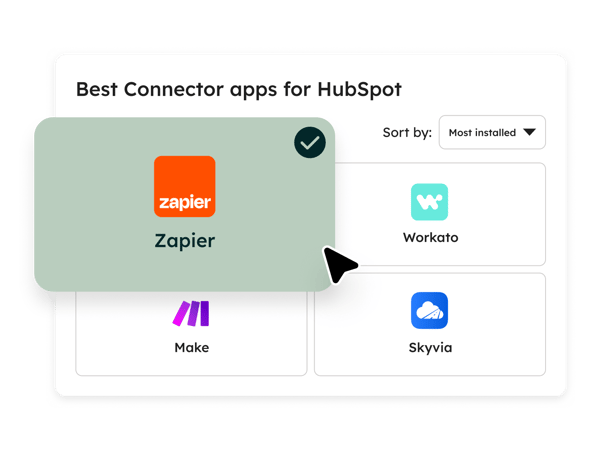
A SaaS company's key data does not live only in the CRM. HubSpot can connect to your product, billing and other applications to give teams the right information.

HubSpot AI

HubSpot's Data and AI capabilities make it easier to use the data in the CRM and connected sources to enrich, analyse and automate some processing.

Copernic in numbers

A Software and SaaS badge.
10+ years of HubSpot projects.

800+clients supported
1,200HubSpot hubs implemented
130HubSpot certifications
4HubSpot accreditations

Key takeaways

One customer, one view.
Shared by all your teams.

For a SaaS company, the CRM goes beyond managing prospects and opportunities. It must track the entire revenue cycle: acquisition, conversion, onboarding, adoption, renewal, expansion and churn.

At Copernic, we believe HubSpot becomes truly structuring when it brings together the data Marketing, Sales and Customer Success need, while staying connected to the product, billing and business tools. The goal is to build one shared customer view, usable by every team.

  • Align Marketing, Sales and Customer Success around the same revenue cycle.
  • Structure New Business, onboarding, renewal and expansion in one consistent CRM model.
  • Connect CRM, product, support and billing data without creating new silos.
  • Track the key metrics: conversion, CAC, MRR, ARR, churn, NRR and LTV.
  • Automate repetitive processes while keeping explicit business rules.
  • Use AI on top of structured, reliable and truly contextual data.

FAQ: HubSpot and CRM for SaaS companies

Is HubSpot a good fit for SaaS companies?

Yes, provided it is structured around the company's real revenue cycle. HubSpot can cover acquisition, sales, onboarding, Customer Success, support and part of revenue steering, while staying connected to product and finance tools.

How do you track ARR and MRR in HubSpot?

The method depends on the source of truth and the business model. We recommend separating sold revenue, active revenue and revenue movements, so you can track New Business, expansion, contraction, renewal and churn without double counting.

Can product data be connected to HubSpot?

Yes. API, Data Sync, middleware or a custom integration can bring in the signals that matter, such as activation, usage, features used or last activity.

How do you manage Customer Success in HubSpot?

HubSpot can structure onboarding, tickets, satisfaction, health score, renewal and follow-up tasks. What matters most is linking this information to the sales and product context.

How do you anticipate churn with HubSpot?

The CRM must combine several dimensions: engagement, usage, incidents, satisfaction, sales relationship and contract due date. The goal is to surface the accounts that need action before the risk becomes critical.

How do you integrate HubSpot with a billing tool?

First define the source of truth for subscription, payment and revenue, then choose the information HubSpot really needs for Sales and Customer Success operations.

How does Copernic support a SaaS company on HubSpot?

We cover CRM and RevOps strategy, HubSpot onboarding and optimisation, migrations, data integrations, Customer Success, automation and team training.

Every churn signal. Caught before cancellation.

Build HubSpot around your subscription model: acquisition, onboarding, renewals, expansion, and track MRR, churn and expansion in one CRM.