RevOps: align your teams, speed up your growth

Copernic turns your silos into a governed, measurable RevOps organization: diagnostic, processes, roles, data, automations and roadmap. RevOps becomes essential as soon as an SMB grows past three teams, and foundational for a mid-sized company or a large enterprise.

Talk to an expert See the case study
HubSpot Elite Partner
800+ clients supported
10+ years of HubSpot expertise
Scope of the expertise

Four calls weigh on your revenue.
Make them before the tool.

A RevOps approach is only worth the decisions it makes possible. Before any configuration, four topics must be settled: how revenue is defined, the target customer journey, each team's responsibility and the shared steering system.

CRM and RevOps consultant
01. Revenue model

Connect the operating organization to the real drivers of your growth.

We clarify how the company acquires, converts, delivers, retains and grows its revenue. Segments, offers, channels, cycle length, recurrence and expansion potential do not create the same operational needs. This reading keeps you from pasting a standard RevOps model onto a more complex economic reality.


What we see

Two companies using the same CRM can need radically different governance.

Revenue Operations expert
02. Journeys and processes

Design a continuous customer cycle that goes beyond the sales pipeline.

We map the handoffs, entry and exit criteria, expected lead times, exceptions and feedback loops between marketing, sales, onboarding and customer service. The goal is not to draw an ideal process. It is to make how things really work explicit, measurable and improvable.


What we see

Revenue leaks often hide between two teams, not inside a stage.

Sales director, revenue steering
03. Roles and governance

Assign every decision, data point and action to an identifiable owner.

We define operational and decision-making responsibilities: who qualifies a lead, accepts a handoff, corrects data, changes a workflow or rules on a KPI. A RACI model (responsible, accountable, consulted, informed) and governance bodies stop the CRM from drifting with every local request.


What we see

A committee with no authority to decide adds meetings, not governance.

Marketing and sales alignment expert
04. Performance measurement

Build shared KPIs that trigger better decisions.

We align volume, conversion, velocity, value and retention KPIs. Marketing cannot be steered on leads alone, sales on signed deals alone, or customer service on tickets alone. Steering must connect activities to business results without a flood of dashboards.


What we see

More KPIs rarely bring more clarity.

What is RevOps, and why does it go far beyond the CRM?

RevOps (Revenue Operations) organizes cross-functional revenue steering across the whole customer cycle. It coordinates strategy, processes, responsibilities, data, technology and performance measurement, from the moment a prospect is acquired to renewal, expansion or churn.

RevOps is not the same as installing a CRM, running a reporting team or adding Sales Ops and Marketing Ops specialists together. A CRM supports the operating model. It does not settle disagreements about sales stages, qualification, data ownership or commitments between teams.

RevOps governance defines who decides, who executes, who checks and under which rules. It turns the CRM into a Single Source of Truth: a shared reference reliable enough to steer the company's actions and trade-offs.

 Revenue strategy
  Cross-functional processes
 Data governance
 Performance steering

Three teams, three versions of the numbers? One is enough.

A RevOps diagnostic pinpoints the process breaks, blurred responsibilities and data that weaken your forecast.

Our vision

A tool digitizes your disagreements.
Governance settles them.

RevOps is neither a new job title nor a renamed CRM project. It is a management discipline that makes trade-offs explicit and execution consistent. Technology amplifies that consistency. It cannot create it on its own.

HubSpot Revenue Hub
Consulting

Strategy & organization

Goal: align teams and resources with the priority drivers of profitable revenue.

What we do: frame the governance, roles, cross-team commitments and customer cycle processes.

Our conviction: without clear organizational decisions, the best CRM only digitizes existing disagreements.

Data Hub - Data Studio
Data

Architecture & interoperability

Goal: establish customer data that is reliable, traceable and usable in every operational decision.

What we do: design the data model, flows, controls, reference data and their owners.

Our conviction: a source of truth cannot be decreed. It is built through responsibilities and controls.

AEO - categories - HubSpot
Technology

HubSpot & execution

Goal: make the CRM an execution system that is adopted, scalable and sized to real needs.

What we do: configure HubSpot, integrate the ecosystem, automate the rules and support usage.

Our conviction: a powerful tool with poor governance grows operational debt faster than performance.

Deliverables

Written roles, shared numbers.
An organization that holds.

Shared processes, responsibilities, data rules and KPIs to align leadership, business teams, IT and integration teams.

RevOps diagnostic

Maturity, pain points, risks and priorities, made objective.

Revenue map

Journeys, stages, handoffs and exceptions documented.

Target processes

Operating rules validated end to end.

RACI matrix

Decision-making and operational responsibilities, clarified.

Data dictionary

Definitions, owners, sources and quality controls.

KPI framework

Calculations, uses and reading levels, shared.

Target architecture

Application roles, flows and systems of record.

Prioritized roadmap

Phases, dependencies, workload and success criteria.

Approach & method

Your processes are fragmented.
Your revenue must not be.

Our approach connects strategy and execution. It starts from business goals, observes real practices and measures the gaps before proposing a target. We don't try to standardize everything that can be standardized: we standardize what must be shared and preserve the variations that create value. Each recommendation becomes a business rule, a responsibility, a data point, an automation or a KPI, then is prioritized by impact and effort.

Understand the business model

We analyze offers, segments, channels, sales models, recurring revenue sources and retention conditions. This step links growth ambitions to the operational capabilities they require and spots inconsistencies between the stated strategy, the targets assigned and the behaviors actually rewarded.

Our recommendation: start from the revenue drivers, never from the org chart or the tool.

Revenue model
Priority segments
Business goals

Map the revenue processes

We map the journey end to end, from the first interaction to renewal. For each stage, we document triggers, criteria, lead times, expected data, owners and exceptions. This map reveals duplicates, manual tasks, breaks in ownership and the moments where the customer experience degrades.

Our recommendation: document frequent exceptions before freezing the target process.

Sales cycle
Customer journey
Handoffs

Clarify the organization and SLAs

We define roles and SLAs (Service Level Agreements) between teams. The criteria for a Marketing Qualified Lead (MQL) and a Sales Qualified Lead (SQL, a lead accepted by sales) become observable rules, not local interpretations.

Our recommendation: tie every commitment to an owner, a deadline and a check.

RevOps roles
Internal SLAs
MQL and SQL

Govern customer data

We audit the data model, properties, sources, duplicates, syncs and quality rules. We specify which data is mandatory, when it is collected, which system creates it and who guarantees its reliability. The single source of reference becomes an organized responsibility, not a technical promise.

Our recommendation: remove unused data before adding new fields.

Data quality
Data model
Source of truth

Build shared steering

We define a KPI hierarchy linking activity, conversion, velocity, revenue and retention. Each dashboard answers a specific decision: allocate investment, prioritize the pipeline, fix a bottleneck or anticipate a risk. Definitions and calculation methods are documented to avoid several competing truths.

Our recommendation: a KPI with no decision attached does not deserve a dashboard.

Shared KPIs
Forecast
Revenue Intelligence

Automate stabilized processes

We translate validated rules into workflows, routing, scoring, notifications, controls and syncs. Automation cuts workload and secures execution once a process is clear. Applied too early, it speeds up errors, hides exceptions and makes the system harder to evolve.

Our recommendation: test a rule manually before automating it at scale.

Workflows
Lead scoring
Routing

Prioritize the transformation

We consolidate the gaps into a roadmap sequenced by impact, dependencies, effort and adoption risk. Quick wins are separated from structural workstreams. Each phase has an expected result, an owner, prerequisites and a success measure, so the transformation outlives the engagement.

Our recommendation: fund governance and adoption as deliverables, not as add-ons.

Quick wins
RevOps roadmap
Change management
Our method

Diagnose, design, implement.
Then measure what changes.

01

Understand · Think

Frame the ambitions

We align leadership on goals, scope, priority pain points and success criteria. Available data and stakeholders are identified from kickoff.

02

Model · Think

Observe reality

Interviews, workshops, CRM analysis and a review of reporting test declared processes against real practice. Gaps are rated by their impact on revenue, data and customer experience.

03

Build · Build

Design and decide

We build the target processes, roles, rules, data and KPIs. Options are put up for decision with their impacts, dependencies and trade-offs, rather than presented as a theoretical target.

04

Prove · Run

Roll out and embed

The roadmap drives configuration, integrations, testing, training and adoption tracking. The governance in place lets you measure results and evolve the setup.

Case study

Delaware France aligns marketing and sales around a shared process.

Copernic helped Delaware France structure its processes and lead follow-up within an international HubSpot instance.

 
delaware logo

Structure the revenue cycle before multiplying automations

Copernic first clarified processes and responsibilities, then translated them into HubSpot. The CRM became a tool for alignment and shared steering.

IT services & Consulting Revenue cycle User adoption

Turn an imposed CRM into a tool teams actually adopt

Context

Delaware France used a HubSpot instance shared across several countries that was still poorly suited to its teams' processes and usage.

Challenge

Make lead follow-up reliable, clarify handoffs and better align marketing and sales without challenging the international architecture.

Intervention

CRM, Sales Hub and Marketing Hub audit, business workshops, pipeline redesign, process documentation and nurturing structure.

Result

A shared marketing-sales process, a formal SLA, follow-up automations and shared dashboards.

See the Delaware case study →

What clients say

A clear strategy.
Autonomous teams.

A clear, measured strategy

“We have a clear view of the strategy in place thanks to regular exchanges and reporting that lets us measure the impact of the actions taken.”
S. LaarissiMGEL · Banking and insurance

Attentive, then autonomous

“Their team really listens to our needs and business challenges, with tailored proposals. Their teaching approach helped us become more autonomous.”
P. CampanellaGolden Bees · Software and SaaS

Advice that serves the business

“Every new idea we had during the project was welcomed with interest by our contacts, and their sound advice helped us make configuration choices that serve our business.”
J. ClamVisiperf · Marketing and media

Reviews translated from French · Scroll →

Artificial intelligence

AI speeds up your processes.
It does not replace their foundations.

Artificial intelligence can analyze more signals, speed up research, recommend an action and carry out certain tasks. But its value depends directly on the context available, data quality and process stability. An AI connected to an inconsistent CRM produces faster answers, not necessarily better ones. So we build AI use cases into RevOps governance: purpose, authorized data, human validation, performance measurement and risk control.

AI for marketing production
01

Conversational assistance

Assistants let users query the CRM in natural language, prepare a meeting, summarize a history or find information without browsing several objects. They cut the time it takes to access knowledge and ease adoption, provided rights, definitions and the sources consulted are under control.

02

AI governance

Every use case needs an owner, a purpose, authorized data, a level of autonomy and a quality indicator. Governance also specifies the cases that require human validation, security rules and audit procedures. AI effectiveness stays tied to that of the underlying RevOps system: explicit processes, reliable data and clear ownership.

03

Autonomous execution

Agents can look up information, enrich records, suggest a follow-up, qualify a request or handle a simple interaction. Their rollout should start with bounded, observable and reversible tasks, with escalation to a human whenever the context, the stakes or the confidence level require it.

04

Predictive analytics

Scoring, forecasting and risk detection can prioritize the accounts, deals or customers that need action. These models enrich the teams' judgment. They do not replace a clear definition of the results you want, nor monitoring for bias introduced by incomplete historical data.

HubSpot

HubSpot carries your rules.
We write them with you.

HubSpot brings CRM, marketing, sales, customer service, content, data and automation together on one platform. This continuity can reduce breaks and speed up steering. It still does not spare you from designing processes, governance and the data model. Copernic translates the target RevOps model into a HubSpot architecture that is maintainable, integrated and adopted.

Data

Build a usable customer reference

We structure objects, properties, associations, deduplication rules, enrichment and syncs. Master systems and responsibilities are defined so that several applications don't create competing versions of the customer. Useful data becomes available to teams without multiplying fields or exposing information they don't need.

HubSpot AI

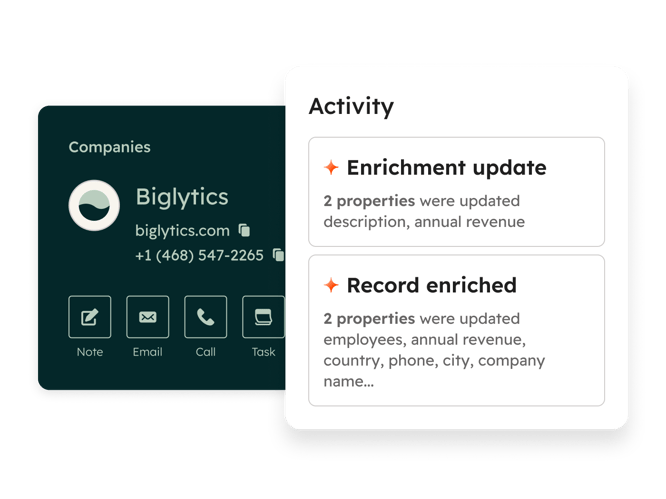
Data enrichment: HubSpot can complete company and contact records with information useful for segmentation and qualification. This data must stay controlled, historized and tied to a specific business use.

Smart CRM - Content Record Enrichment
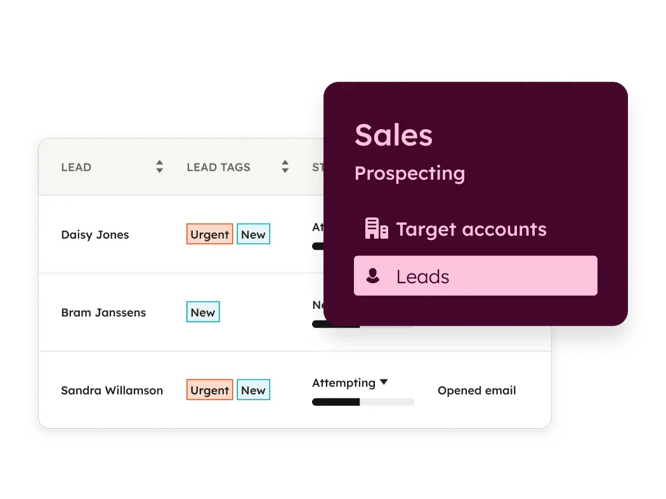
HubSpot Sales Hub - Sales Lead Management
Processes

Orchestrate the handoffs

We configure pipelines, stages, required properties, routing, scoring, SLAs, sequences and workflows according to the validated rules. Automations cover the standard cases and make exceptions visible. Teams keep a shared process without being locked into a journey that cannot reflect sales or customer reality.

HubSpot AI

Smart Deal Progression: after a sales conversation, HubSpot can suggest next actions, prepare follow-ups and make it easier to update the CRM. The feature supports the sales process without replacing the qualification criteria set by the company.

Steering

Turn data into shared decisions

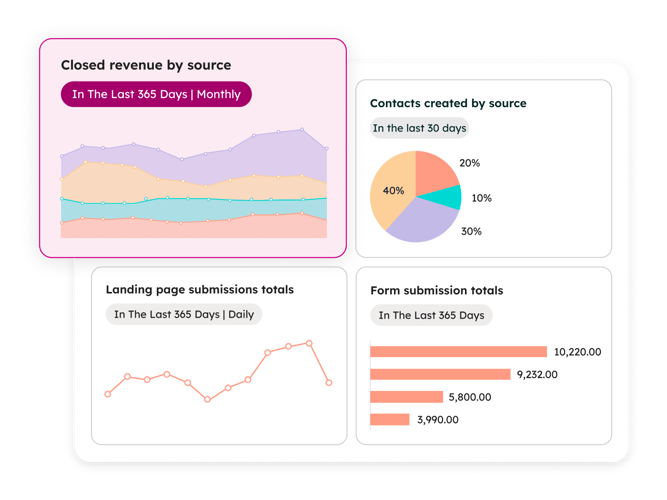
We build reports on the funnel, velocity, sources, forecast, retention and data quality. Each dashboard has an audience, a review rhythm and an attached decision. Definition gaps are resolved upstream so meetings focus on action, not on whether the numbers are right.

HubSpot AI

Predictive scoring: analyzing historical data helps identify the leads most likely to convert. The model complements business scoring, but its relevance depends on the volume, quality and representativeness of the data available.

HubSpot CRM - report
Smart CRM - CRM Overview
Scalability

Evolve the CRM without losing consistency

We set rules for design, documentation, testing, release and change review. Rights, teams, naming conventions and test environments limit debt. HubSpot can then support new offers, entities or regions without becoming a pile of local fixes.

HubSpot AI

Breeze Assistant: users can query their CRM context, prepare a meeting or summarize a history directly in HubSpot. The assistant eases adoption while respecting existing access rights and governance rules.

Baptiste Collignon, HubSpot project manager at Copernic
Your teams don't lack tools.
They lack shared rules.
Baptiste Collignon · HubSpot project manager

Key takeaway

Clarify the rules.
Then automate.

RevOps, or Revenue Operations, is a steering model that aligns marketing, sales and customer service around shared processes, data, tools and KPIs to make revenue more efficient and more predictable.

We don't start by automating HubSpot. We start by clarifying the customer journey, responsibilities, business rules and the decisions your data must make possible.

  • Connect goals to operational processes
  • Define a common language across teams
  • Reduce friction in the sales cycle
  • Make data reliable before using it
  • Automate only stabilized processes
  • Steer acquisition, conversion and retention together
Why Copernic

Aligning three teams can be learned.
We have done it for 10+ years.

Copernic is a HubSpot Elite Partner. For 10+ years, we have helped marketing, sales and customer service teams share the same processes, data and KPIs in HubSpot.

800+clients supported
1,200HubSpot hubs implemented
4.9/5from 300+ client reviews

FAQ: frequently asked questions about RevOps

What is the difference between RevOps and Sales Ops?

Sales Ops optimizes sales operations. RevOps coordinates marketing, sales and customer service across the whole revenue cycle.

How much does RevOps support cost?

The budget depends on scope, the number of teams, the complexity of your information system and the level of execution expected after the diagnostic.

How long does a RevOps project take?

A targeted diagnostic can take a few weeks. A transformation including implementation and adoption is usually run in several phases.

What results can we expect?

Smoother processes, more reliable data, a better-steered cycle, clear responsibilities and a sturdier revenue forecast.

Should you hire a RevOps manager before getting started?

Not necessarily. Leadership can first frame the model, appoint a sponsor and split responsibilities across existing functions. Hiring makes sense when the volume of coordination, analysis and continuous improvement justifies a dedicated role. Copernic can structure the function, define its job description and organize the transition to an in-house team.

Do RevOps, CRM and CRM transformation mean the same thing?

No. RevOps is an operating model for steering revenue. The CRM is a platform that centralizes data and supports interactions. A CRM transformation is a change program covering usage, processes, data and tools. A CRM project can contribute to a RevOps strategy, but installing a CRM is not enough to align goals or settle organizational trade-offs.

Does a RevOps approach mean switching CRMs?

No. The diagnostic may conclude that the current CRM is fine but poorly governed, poorly integrated or not adopted enough. A change of tool is only justified if functional, architectural, economic or regulatory limits block the target. Copernic first assesses the gaps between needs and capabilities before recommending any technology change.

How does the Customer Service department contribute to RevOps?

Centrally. Customer service holds key signals on adoption, satisfaction, churn risk, renewal and expansion. Leaving it out limits RevOps to acquisition and sales. The Customer Service department must help define the journey, customer health data, handoffs and retention KPIs.

What role do IT and the CRM manager play?

A structuring role. IT secures the architecture, integrations, access and compliance. The CRM manager guarantees functional consistency, documentation and usage. Neither should carry business decisions alone, though. The RevOps sponsor organizes decision-making with the Marketing, Sales and Customer Service departments, while Copernic bridges business stakes and technical constraints.

Who should lead RevOps: the CEO, a CRO or operations?

It depends on maturity. The CRO (Chief Revenue Officer) can own the cross-functional responsibility when they truly control acquisition, sales and retention. Otherwise, a committee sponsored by the CEO can make the calls, with a RevOps manager in charge of execution. What matters is not the title: it is the authority available to resolve conflicts over goals, resources and priorities.

What deliverables do you hand over at the end of the engagement?

Artifacts you can use right away. Depending on scope: maturity diagnostic, revenue cycle map, target processes, RACI matrix, data dictionary, KPI framework, target architecture, automation backlog and prioritized roadmap. For each deliverable, Copernic specifies the owner, the expected use and the decisions it must support.

Can Copernic step in before HubSpot is chosen?

Yes. Upstream scoping defines needs, processes, data, integrations and selection criteria before the tool shapes the target. Copernic can also assess how well HubSpot fits your context, build the architecture and prepare the rollout trajectory. The recommendation must start from the operating model you want, not from a product demo.

Less friction between teams. More predictable revenue.

Audit, CRM governance, target processes, data architecture and roadmap: turn your silos into a revenue system that is consistent, measurable and scalable.