Automate your marketing campaigns at scale

Copernic structures your templates, processes and HubSpot environment so you can launch reliable, consistent and measurable marketing campaigns faster.

Talk to an expert See the case study
HubSpot Elite Partner
800+ clients supported
10+ years of HubSpot expertise
Challenges

Starting from scratch is costly.
Starting from a template pays.

Industrializing marketing campaigns cuts production time, tightens quality control on assets and expands your teams' execution capacity. It becomes strategic when more offers, audiences, markets and channels turn every campaign into a complex technical project.

Standardized marketing campaign production

Cut the hidden cost of repetition

A landing page, email or thank-you page that is rarely reused costs far more than creation time. You also have to find the right content, check settings, chase several approvals and rebuild the same connections. Robust templates and clear naming conventions cut this hidden cost while preserving creative freedom.

What we see
The best-performing teams do not create more campaigns. They smartly reuse what already works.
Launching a HubSpot campaign

Launch faster without sacrificing quality

Speed of execution must not lead to more misconfigured forms, inconsistent lists or conflicting workflows. A replicable campaign architecture shortens lead times while building in the essential checks: consent, segmentation, attribution, internal notifications, conversion tracking and exclusion of irrelevant audiences.

What we see
Most delays come from approvals, rework and configuration errors, far more than from content creation.

Automated marketing journey

Keep the experience consistent at scale

The more campaigns multiply, the greater the risk of drift between messages, the
brand guidelines, the fields requested and the sales promises. Automation must therefore support
a consistent experience, whatever the channel. Teams share a common framework, while
variations remain possible by audience, industry and maturity level.

What we see
When each team builds its own templates, the customer experience
quickly becomes uneven despite shared brand guidelines.

Marketing performance analysis

Make performance truly comparable

A campaign cannot be improved when each team uses its own conventions,
statuses and KPIs. Standardization makes it easier to compare inbound and
outbound campaigns, emails, events, SMS and downloadable content. It gives
leadership a more reliable reading of investments, conversions and contribution to
pipeline.

What we see
Marketing leaders often have plenty of dashboards
but still struggle to compare two campaigns objectively.

What is marketing campaign automation?

Automating your marketing campaigns means standardizing and orchestrating the creation, approval, distribution and measurement of recurring assets: landing pages, thank-you pages, emails, forms, lists, SMS campaigns or workflows. Copernic, a HubSpot Elite Partner consulting firm, helps marketing teams industrialize this production without degrading personalization, data quality or brand consistency.

The goal is not to replace marketers with workflows. It is to remove repetitive tasks, secure dependencies between tools and let teams spend more time on targeting, messaging, creation and analysis. This approach differs from marketing automation in the strict sense, which focuses more on triggering relationship scenarios based on a contact's behavior or profile.

 Campaign templates
  HubSpot workflows
  Automated nurturing
 Quality control
01

Structured brief

Goal, audience, offer, message, channel and KPIs are framed in a shared format.

02

Reusable assets

Teams rely on reliable templates rather than starting from scratch every time.

03

Orchestrated activation

Lists, emails, forms, workflows and campaigns are connected according to controlled rules.

04

Consolidated measurement

Performance is compared using shared naming conventions and KPIs.

Your website attracts. Your CRM must convert.

We audit your assets, approval processes, workflows and HubSpot architecture to identify repetitive tasks and quality risks.

Our vision

Your teams decide.
Workflows execute.

Copernic treats marketing campaign automation as a matter of organization,
design and data governance before it is a technical project. We combine operational
consulting, HubSpot expertise and data architecture to build a system your teams
can actually use, control and evolve.


Marketing scoping workshop

Consulting to decide what should be automated

Not every repetitive task deserves the same level of automation. Some should be removed, others simplified and only a few orchestrated in HubSpot. We analyze frequency, risk, value created and the level of personalization expected. This approach avoids digitizing useless processes or speeding up practices that are already inconsistent.

HubSpot configuration

HubSpot expertise to keep the system maintainable

Elite Partner status is not just functional knowledge of the software. Our consultants structure objects, properties, workflows, campaigns, forms and user permissions to keep the environment readable. The challenge is not only to nail the first launch, but to let teams reproduce the campaign several months later.

Data-driven marketing management

Data to personalize without losing control

Personalization becomes risky when segmentation rules rely on incomplete or ambiguous data. We make sources, conventions and update rules reliable before building scenarios. Campaigns can then adapt messages by industry, profile, maturity or behavior without multiplying branches that are impossible to audit.

Our method

We scope before we build.
You validate every step.

01

Understand · Think

Audit of campaigns, assets and dependencies

We analyze recurring campaigns, production times, existing templates, workflows, properties, lists and approvals. This audit identifies needless repetition, quality risks and the automations that can quickly deliver an operational gain.

02

Model · Think

Design of the target architecture and standards

We define templates, naming conventions, roles, segmentation rules, reporting conventions and the necessary checks. Decisions are translated into a clear functional architecture before any technical configuration.

03

Implement · Build

Configuration, testing and rollout of automations

Copernic builds the assets, configures HubSpot workflows, makes data reliable and tests scenarios on real cases. Teams validate entry criteria, exclusions, content, notifications and expected results before rollout.

04

Steer · Run

Training, adoption and continuous improvement

We train users to produce and measure their campaigns with the new standards. The first activations are then used to fine-tune templates, workflows and dashboards.

Approach & method

A production system.
Not a string of campaigns.

Copernic industrializes marketing campaigns across six complementary dimensions:
governance, templates, data, orchestration, measurement and adoption. These pillars are not a
rigid sequence. They form the system you need to produce faster without piling up
operational debt in HubSpot.

Set up explicit campaign governance

Automation starts with clear rules: who writes the brief, who validates targeting,
who checks the assets and who decides on launch. Copernic formalizes responsibilities, approval
levels and compliance criteria. This governance prevents a workflow from artificially making up
for a missing decision, or a campaign from getting stuck between several teams.

Our recommendation: limit approvals to the truly sensitive points and automate objective checks. An overly long approval chain slows production without necessarily improving quality.


Build a library of truly reusable assets

Effective templates are not just graphic duplicates. They include
editable areas, brand rules, forms, tracking settings, legal notices and the components needed for reporting. Copernic designs landing pages, thank-you pages, emails and HubSpot modules suited to recurring use cases, with a defined level of flexibility.

Our position: a template that is too locked will be bypassed. A template that is too open will repeat existing mistakes. The right level of standardization depends on risk, frequency and user autonomy.

Orchestrate HubSpot workflows without building a monster

HubSpot workflows can automate enrollment, qualification, email sends, task creation, property updates and notifications. Copernic organizes this orchestration with readable conventions, controlled re-enrollment criteria and exclusion mechanisms.
The goal is automations your teams can understand, maintain and audit.


Our view: a workflow should not handle several independent processes. We favor targeted, documented automations linked by explicit data rather than one central scenario
that is impossible to maintain.

Connect campaigns, acquisition and sales performance

A marketing campaign is not just its open rate or the number of forms submitted. Copernic defines a measurement architecture linking channel, campaign, conversion, sales cycle and revenue. Naming conventions, UTM parameters, campaign statuses and dashboards let you compare activations and identify points of
failure.


Our recommendation: separate production, engagement, conversion and pipeline contribution KPIs. Mixing these levels often leads to overvaluing volume and under-
analyzing quality.

Give teams the autonomy they need

Automation succeeds when users understand the system and can run it without relying on an admin for every change. Copernic supports teams with operational documentation, use-case training and suitable control rules.
We measure adoption through real practices: brief quality, template usage and
compliance with conventions.


Our recommendation: train teams on real campaigns rather than on a
generic feature demo. Learning becomes immediately actionable and exposes the limits of the setup faster.

Baptiste Collignon, HubSpot project manager at Copernic
Every lead has a source.
Every source must pay off.
Baptiste Collignon · HubSpot project manager
Case study

How Effy structured its marketing automation with HubSpot

Copernic supported Effy on its HubSpot marketing strategy, from recommendations to the operational rollout of landing pages, workflows and scoring mechanisms.

Effy logo in white
 

Moving from scattered marketing actions to an orchestrated setup.

The challenge was to structure marketing activations in HubSpot and connect the different operational levers. Copernic supported Effy on strategy, the action plan and the configuration of the components needed for execution.

Energy Marketing automation HubSpot integration

Marketing automation as a system, not a pile of workflows

Context

Effy wanted to structure its HubSpot marketing setup and have a consistent framework to run its campaigns and use the data collected.

Challenge

Strategy, landing pages, workflows and scoring had to be brought together to make execution smoother and actions more measurable.

Intervention

Copernic supported the teams on recommendations, the action plan and the operational setup of the main marketing components in HubSpot.

Result

Effy gained a more structured setup, linking strategy to the tools needed to launch, qualify and steer marketing activations.

See the Effy case study →

What clients say

Their campaigns go out on time.
Their teams save time.

HubSpot Marketing integrated with the CRM

“Copernic's teams fully understood our business needs and our marketing challenges and responded effectively by integrating the HubSpot Marketing platform with our CRM.”
R. CzerwiecCERAN · Education and training

A HubSpot marketing setup put back in order

“We worked with Copernic to put our HubSpot back in order, especially on the marketing & data side. Thomas supported us for several months with great teaching skills, which helped us both reach our business goals and grow more autonomous on HubSpot.”
S. MillotDJUST · Software and SaaS

Scenarios delivered on schedule

“We worked with Copernic to integrate marketing automation scenarios […] Copernic's expertise saved us a lot of time and let us deliver on schedule.”
L. de Saint AndrieuFrance Valley · Banking and insurance

Scroll →

Reviews translated from French.

Artificial intelligence

AI writes the first draft.
Your teams approve it.

Artificial intelligence is not just for writing faster. Built into clear processes, reliable templates and structured CRM data, it speeds up the whole campaign production cycle, from the first idea to performance optimization.

An accelerator, not an autopilot.

Produce more without multiplying manual tasks

At Copernic, we use AI to cut repetitive tasks and speed up first drafts. Teams remain responsible for positioning, targeting, the offer, approvals and steering decisions. The goal is not to generate more content to fill channels. It is to shorten the time between the idea, going live and learning, while keeping clear governance in HubSpot.

AI for marketing production
01

Create first deliverables faster

AI prepares a first version of a landing page, email, form, CTA or thank-you page. Teams start from a structured base rather than a blank page.


02

Adapt content by audience and channel

A campaign can be adapted by persona, industry, maturity, language or channel. Variants stay tied to a core message and shared brand rules.

03

Personalize from CRM data

Connected to HubSpot data, AI helps prepare more contextual messages based on the contact's profile, behavior or history, provided the data is reliable and well governed.

04

Spot optimization leads faster

AI can summarize results, surface gaps between segments and identify the content or steps that hold back conversion. The final decision stays with your teams.

HubSpot

A blank page for every campaign?
HubSpot hands you a template.

Creating a campaign should never mean starting from a blank page. HubSpot lets you build reusable templates for landing pages, emails, forms and thank-you pages to speed up production while respecting your brand guidelines, tracking rules and best practices.

Campaign production

Standardize your campaigns without limiting creativity

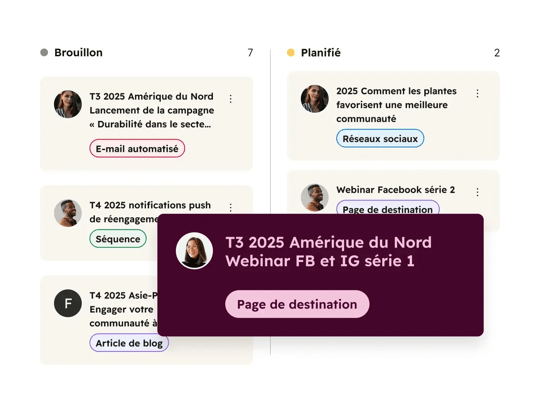
Creating a new campaign should never mean starting from scratch. HubSpot lets you design reusable templates for landing pages, emails, forms and thank-you pages to speed up production while ensuring a consistent experience. Teams gain speed without losing the ability to adapt content to each campaign's goals.

HubSpot AI

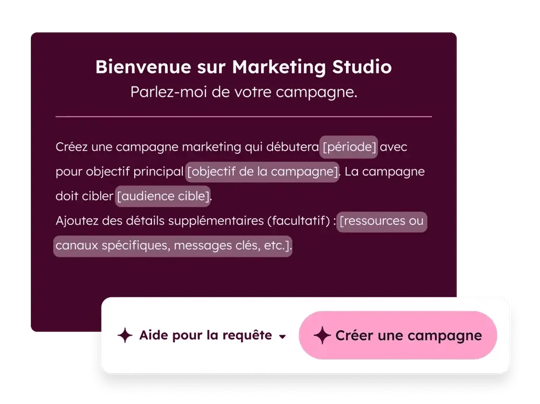
Marketing Studio helps marketing teams turn a brief into a campaign ready for production. AI structures the messages, recommends the channels to activate and generates the first content to speed up campaign launches.

Marketing Hub: Kanban board
Marketing automation workflow
Marketing orchestration

Automate journeys without building a monster

A high-performing campaign rests on a sequence of coordinated actions. HubSpot orchestrates workflow enrollments, nurturing scenarios, internal notifications and data updates to ensure smooth, controlled execution. The goal is not to multiply automations, but to build processes that are simple, understandable and easy to maintain.

HubSpot AI

You can build AI agents directly into HubSpot workflows to automate complex processing. They can analyze context, produce content or enrich data before automatically continuing the marketing scenario.

Campaign personalization

Tailor every campaign to its audience

Automation really pays off when it lets you personalize interactions. HubSpot uses CRM data and contact behavior to adapt content, calls to action or marketing scenarios by profile, industry or prospect maturity.

HubSpot AI

HubSpot AI helps teams personalize content based on contacts' characteristics and behavior. Campaigns stay industrialized while delivering more relevant messages for each audience's profile, intent or maturity.

Marketing Hub: campaign
HubSpot Marketing Hub reporting and marketing analytics
Steering

Measure what really improves your campaigns

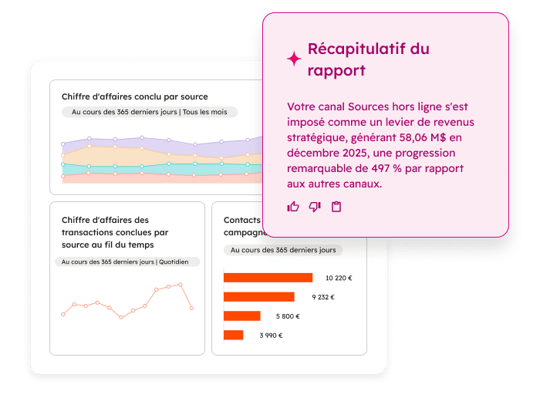
Industrializing campaigns also means measuring their performance consistently. HubSpot centralizes production, engagement, conversion and pipeline contribution KPIs to identify improvement levers and base marketing decisions on reliable data.

HubSpot AI

Breeze Assistant helps teams interpret campaign results, summarize observed performance and spot optimization leads faster for future activations.

Copernic in numbers

10+ years of HubSpot.
Nothing else.

Copernic supports organizations that want to structure their marketing, sales and customer service processes in HubSpot, with an approach that blends consulting, integration, RevOps and data quality.
800+clients supported
1,200HubSpot hubs implemented
130HubSpot certifications
4HubSpot accreditations

Key takeaways

More campaigns.
Less complexity.

Automating your marketing campaigns means standardizing how campaigns are created, launched and steered to produce faster, with fewer errors and comparable results. At Copernic, an automated campaign is a production system: before configuring HubSpot, we define the processes, templates and KPIs.

  • Standardize recurring landing pages, emails and forms
  • Structure approval processes before automating them
  • Make targeting and personalization data reliable
  • Orchestrate simple, documented HubSpot workflows
  • Launch more campaigns without weighing down the organization
  • Make the CRM the source of truth for reporting

FAQ: marketing campaign automation

Marketing campaign automation raises questions of scope, cost, governance and quality. Here are the answers to the questions marketing and executive leaders ask most often.


What is the difference between campaign automation and marketing automation?

Campaign automation is mainly about industrializing their
production, while marketing automation automates interactions based on contacts' data and behavior. The first covers page templates, emails, forms, approval processes and reporting. The second notably covers automated nurturing, qualification and triggered scenarios.
The two are complementary. An organization can have advanced workflows while losing several days rebuilding each campaign. Conversely, it can have good templates without using relationship scenarios. Copernic handles both dimensions while clearly separating goals and responsibilities.

Which marketing assets can be automated with HubSpot?

HubSpot can industrialize landing pages, thank-you pages, forms, marketing emails, lists, workflows, campaigns, internal notifications and dashboards. You can also reuse modules, sections and personalization rules to speed up creation.

The level of automation depends on how repetitive the use case is and the associated risk. A recurring event campaign can be heavily standardized. A strategic campaign aimed at a narrow audience will need more personalization and human review.


How long does it take to automate your marketing campaigns?

A first scope can be structured in a few weeks, but the timeline depends on the number of assets, data quality and the complexity of approvals. A project focused on one type of recurring campaign will be faster than a full overhaul of the HubSpot environment.

Copernic recommends starting with campaigns that are frequent, time-consuming and stable enough. This selection delivers visible gains without prematurely automating processes that are still shifting. The initial audit is there precisely to prioritize these use cases.


Does automation reduce campaign personalization?

Well-designed automation does not reduce personalization: it standardizes the technical components to free up time for targeting and messaging. Teams can keep editable areas, adapt content by audience and use HubSpot data to personalize certain sections.

The risk appears when templates are too rigid or personalization relies on unreliable data. Copernic therefore defines fixed, variable and conditional elements based on goals, team maturity and compliance constraints.


How do you avoid creating too many HubSpot workflows?

To avoid workflow sprawl, you need naming conventions, a functional scope per automation and ownership rules. Each workflow must serve an identifiable goal, with documented entry, exit, re-enrollment and exclusion criteria.

Copernic also runs periodic reviews to identify redundant, obsolete or conflicting workflows. Best practice is not to group every rule in a single workflow, but to build targeted, readable automations linked by clearly governed properties.


How do you measure the ROI of automated campaigns?

ROI is measured both through productivity gains and through improved marketing and sales performance. KPIs can include production time, time to launch, error rate, conversion, cost per opportunity and pipeline contribution.

Copernic separates operational savings from business results. A campaign launched twice as fast does not automatically generate twice the revenue. Reporting must therefore connect production efficiency, audience engagement, lead quality and sales results.


Should you clean your data before launching automated nurturing?

The data used to enroll, exclude or personalize contacts must be made reliable before launching automated nurturing. You do not need to clean the entire CRM, but the critical properties of the scenario must have a clear definition, source and update rule.

Copernic checks consent, lifecycle stage, industry, profile, interactions and sales statuses in particular. This preparation reduces targeting errors, ill-suited communications and contacts kept too long in a scenario that is no longer relevant.


Is campaign automation also right for small marketing teams?

Small marketing teams often have the most to gain from standardized production, because every repetitive task cuts their capacity to work on strategy and creation. The key is to automate a limited number of high-frequency use cases rather than build a complex architecture right away.

Page templates, a few well-defined workflows, controlled lists and simple reporting can already deliver significant gains. Copernic adapts the level of sophistication to internal resources and real maintenance capacity.


More leads is good. Better-handled leads is better.

Copernic analyzes your recurring campaigns, templates, data and approval processes to identify the automations that truly matter. Our HubSpot Elite Partner team draws on 800+ projects to build a system suited to your organization and maintainable by your teams.