Scale your customer service with CRM, AI and automation

Scaling your customer service means turning a reactive support team into an organization that can handle more requests, with consistent quality, controlled response times and a uniform customer experience.

Talk to an expert See the case study
HubSpot Elite Partner
800+ clients supported
10+ years of HubSpot expertise
Challenges

A customer who waits leaves.
A customer who is served stays.

Scaling your customer service is not just about absorbing more requests. It is about building an organization that delivers consistent service quality whatever the activity volume. To get there, companies must balance customer experience, operational efficiency, cost control and performance management. The most lasting transformations are built on exactly this balance.

business processes

Deliver consistent service quality

Customers expect fast, consistent and personalized answers, whatever the channel. To guarantee this quality over time, companies must standardize their processes, share knowledge across teams and rely on shared handling rules. This consistency strengthens customer trust and makes onboarding new staff easier.


What we see

Quality gaps rarely come from the teams. They are most often caused by processes that differ by channel, product or agent.

data

Improve team productivity

As request volume grows, agents spend a growing share of their time on repetitive tasks: qualification, assignment, information searches or admin follow-up. Scaling these activities lets teams refocus on complex situations and high-value conversations while increasing their handling capacity.


Our recommendation

Start by identifying the repetitive tasks that bring no value to the customer. They are the first candidates for automation and AI assistance.

team alignment

Steer performance with reliable data

Scaling a customer service team means measuring what really matters: response times, SLA compliance, resolution rate, customer satisfaction or team workload. By centralizing data in a CRM, managers get reliable KPIs to spot friction points, adjust resources and keep improving their processes.


Our view

KPIs should not only feed dashboards. They must help quickly spot blockers and improve processes continuously.

CRM implementation

Support growth without complicating the organization

Opening new channels, growing the customer base or launching new offers should not degrade support quality. A structured organization, combined with a CRM, automation and artificial intelligence, lets you scale without multiplying tools, procedures or hires.


What we see

The companies that scale for the long term are not the ones that hire fastest, but the ones that standardize their methods before speeding up.

Why scale your customer service?

As customer requests grow and communication channels multiply, traditional management methods quickly reach their limits. Teams spend more time dispatching requests, searching for information or doing admin tasks than actually helping customers.

Scaling your customer service is not just about automating tasks or rolling out a new tool. It is above all about designing an organization that can scale, with clear processes, reliable data, consistent handling rules and shared steering KPIs.

This approach cuts handling times, improves customer satisfaction, strengthens collaboration between teams and gives agents the means to focus on the situations where their expertise adds the most value.

At Copernic, we are convinced that technology is never the starting point. CRM, artificial intelligence and automation only deliver lasting results when they rest on an organization designed to provide high-performing, scalable, customer-centric service.

 CRM & Service Hub
 AI & Automation
 SLA & Steering
 Customer satisfaction
Reactive customer service
Scaled customer service
1.
Requests arrive in several tools
All interactions are centralized in the CRM
2.
Tickets are dispatched manually
Requests are automatically qualified and assigned
3.
Answers depend on each agent
Processes guarantee consistent quality
4.
KPIs are tracked occasionally
SLAs and KPIs are steered in real time
5.
Teams spend time on repetitive tasks
AI and automation assist teams every day

Our conviction: high-performing customer service rests first on a clear organization. CRM, AI and automation then speed up its execution.

Your agents handle more. Your customers wait less.

High-performing customer service does not rest on a tool alone. It relies on clear processes, reliable data and an organization able to support your growth. Let's talk about your challenges and identify the levers best suited to your context.

Our vision

Your peak loads come back.
Your organization is ready.

At Copernic, we see scaling customer service as an organization project first. Tools, automation and artificial intelligence only deliver lasting results when they rest on clear processes, reliable data and shared business rules. That is why we always start by understanding how you work, your goals and your constraints before recommending any technology.

Lead nurturing automation

Advise before implementing


Every company has its own organization, service commitments and operational constraints. Our role is to analyze the current setup, identify friction points and design a target model able to support your growth. We do not try to copy a standard model, but to build an organization that fits your business challenges.

HubSpot data model

Get the full potential of HubSpot


HubSpot is an excellent foundation to centralize customer interactions, structure processes and automate operations. Its rollout still has to reflect your organization. We configure the CRM to fit your teams, SLAs, assignment rules and performance KPIs, so it becomes a real steering tool.

HubSpot sales data

Turn data into a performance lever


Every customer interaction is a valuable source of information. By structuring data, defining the right KPIs and using the CRM's analytics, we help companies better understand their activity, anticipate friction points and keep improving their service quality.

Our method

Planned path, actual path.
The gap, every quarter.

Scaling customer service is not just about rolling out a CRM or automating a few tasks. Our method aims to build a lasting organization, able to support your growth, improve the customer experience and ease team adoption. Each stage prepares the next to secure the project and deliver lasting results.

01

Understand · Think

Audit the current setup

We analyze your processes, tools, KPIs and request handling journey. This phase identifies friction points, information gaps, repetitive tasks and improvement opportunities.

02

Model · Think

Design the target organization

Together with your teams, we define the priority processes, SLAs, assignment rules, CRM objects, steering KPIs and automations. The goal is to build a simple, scalable model suited to your operational constraints before any technical implementation.

03

Implement · Build

Roll out and automate

We configure HubSpot, integrate your tools, migrate data if needed and implement workflows, business rules and the first artificial intelligence use cases. Each change is validated with the teams to guarantee everything works from go-live.

04

Steer · Run

Support continuous improvement

Go-live marks the start of an optimization approach. We track performance KPIs, analyze team feedback and evolve processes, automations and AI usage to improve service quality and productivity for the long term.

Approach & method

A well-routed ticket.
A customer well kept.

Scaling customer service is not about stacking tools or automating every interaction. It is about building an organization able to handle a growing volume of requests without degrading service quality. At Copernic, we rely on six complementary levers: organization, data, CRM, automation, artificial intelligence and steering. Together, they improve team productivity, customer satisfaction and operational performance for the long term.

Structure handling processes

Scaling customer service starts with defining shared rules. Request qualification, prioritization, escalations, service levels (SLAs) or closing conditions: every stage must be documented and shared. This standardization guarantees consistent service quality, makes onboarding new staff easier and limits handling gaps between teams. It is also the essential foundation for any automation effort.

Our recommendation: formalize your processes before automating them. A workflow or an AI agent will only apply the rules you give it.

Centralize customer knowledge

Every interaction should enrich a single customer view. By centralizing requests, sales conversations, contracts, purchases and interventions in the same CRM, agents immediately have the context they need to answer relevantly. This 360° view avoids re-entry, improves answer personalization and fosters better collaboration between sales, marketing and customer service teams.

What we see: the best customer service teams no longer search for information. They find it instantly.

Remove repetitive tasks

Automation cuts the no-value actions that slow teams down. Automatic request assignment, follow-ups, notifications, status changes or task creation: these mechanisms smooth operations while limiting errors. Agents can then spend more time on complex situations, supporting customers and resolving sensitive cases.

Our view: the goal is not to replace teams, but to remove the tasks that keep them from bringing their real value.

Develop self-service

Not every request needs an agent. A knowledge base, a customer portal or a chatbot let users quickly find answers to the most frequent questions. This autonomy improves the customer experience while reducing the volume of requests sent to teams, who can focus on higher-value requests.

Our recommendation: keep agents for the situations where a human really makes the difference.

Measure to improve

High-performing customer service relies on reliable KPIs: response times, SLA compliance, resolution rate, customer satisfaction (CSAT), Net Promoter Score (NPS) or team workload. This data helps identify friction points, adjust resources and keep improving processes. Without steering, it becomes hard to measure the impact of the actions taken.

What we see: companies that steer their customer service with reliable data make faster, better decisions.

Speed up teams

Artificial intelligence complements agents' work by summarizing conversations, suggesting answers, automatically categorizing requests or detecting recurring trends. Used well, it cuts handling times and improves answer quality. Its effectiveness, however, depends on the quality of the data and processes it relies on.

Our position: AI replaces neither teams nor organization. It becomes a real performance lever when built into a coherent CRM and RevOps strategy.

Baptiste Collignon, HubSpot project manager at Copernic
Customer service is not a cost.
It is your retention.
Baptiste Collignon · HubSpot project manager
Case study

How Ornikar scaled its customer service with HubSpot

Education & Mobility Service Hub CRM transformation
 Ornikar

Transform a fast-growing customer service team without interrupting operations.

Facing a steadily growing volume of requests, Ornikar wanted to rethink all its Sales, Customer Service and Support processes. The goal was not just to change tools, but to build an organization able to absorb growth while improving service quality.

See the Ornikar case study →

The CRM as a lever for operational transformation.

Context

Customer service handled a large volume of requests with uneven, barely automated processes. Ticket assignment, response time tracking and request qualification still relied largely on manual work.

Challenge

Structure handling processes, improve SLA steering and cut response times without disrupting team operations during the transformation.

Intervention

Copernic fully redesigned the customer service organization in HubSpot: automatic ticket assignment, visible SLAs, Aircall and IVR integration, automatic acknowledgment emails, a dedicated form and real-time steering dashboards.

Result

A clearer organization, documented processes and performance management shared by Marketing and Sales.

 
100%
Tickets assigned automatically
 
95%
Reduction in closing time
 
44.5%
Call volume

What clients say

Their support changed tools.
Their customers noticed nothing.

HubSpot for customer service

“We worked together on rolling out HubSpot for our customer service. This collaborative work proved effective and helped our organization improve how it manages customer relationships.”
J. HamonVEHIPOSTE · Transport and mobility

From Zendesk to HubSpot ticketing

“Copernic helped us migrate from Zendesk to HubSpot's ticketing system, and everything went pretty smoothly.”
R. GarrattPix4D · Software and SaaS

Redesigning sales, customer service and support

“We had major projects to carry out to redesign our operational processes (Sales, Customer Service, Support) […] while ensuring business continuity.”
A. GribaudoMarianne Formation (Ornikar) · Education and training

Scroll →

Reviews translated from French.

Artificial intelligence

AI drafts the answer.
Your agents sign it off.

Artificial intelligence does not replace customer service teams. It does, however, considerably cut the time spent on repetitive tasks, improves answer quality and makes large request volumes easier to handle. Combined with a structured CRM, it becomes a real assistant able to analyze conversations, produce summaries, recommend actions and help agents answer faster while keeping service quality consistent.

AI for marketing production
01

Faster answers

AI assists agents by generating answer suggestions suited to the customer's context. It draws on conversation history, company knowledge and CRM information to speed up request handling while keeping a high level of personalization. Teams become more responsive without sacrificing conversation quality.

02

Conversations summarized automatically

AI agents analyze calls, emails and conversations to automatically produce a clear summary of the exchanges. Key information is saved in the CRM, limiting re-entry and letting any agent pick up a case with full context.

03

Smart qualification

AI automatically identifies a request's topic, detects its priority level and can suggest a category or a suitable assignment. Teams spend less time sorting requests and can handle high-value requests faster.

04

Continuous service improvement

By analyzing thousands of conversations, artificial intelligence brings out recurring questions, friction points and reasons for dissatisfaction. This information helps improve processes, enrich the knowledge base and identify automation opportunities.

HubSpot

One more tool is not enough.
HubSpot connects the whole journey.

Scaling customer service is not about adding a new tool, but about having a platform able to centralize data, automate processes and steer performance. HubSpot brings all these building blocks together in a single platform. Combined with work on organization and processes, it improves the customer experience, team productivity and service quality for the long term.

Organization

Centralize all customer interactions

High-performing customer service rests on a complete view of each customer. HubSpot gathers emails, calls, tickets, conversations, forms and deals on a single record so every agent immediately has the right context. This centralization eases collaboration between teams and guarantees consistent follow-up across the whole customer journey.

HubSpot AI

HubSpot AI agents automatically analyze conversations, summarize exchanges and highlight key information. Agents immediately find a case's context without scrolling through the full history.

HubSpot help desk
HubSpot customer service ticket resolution
Automations

Smooth request handling

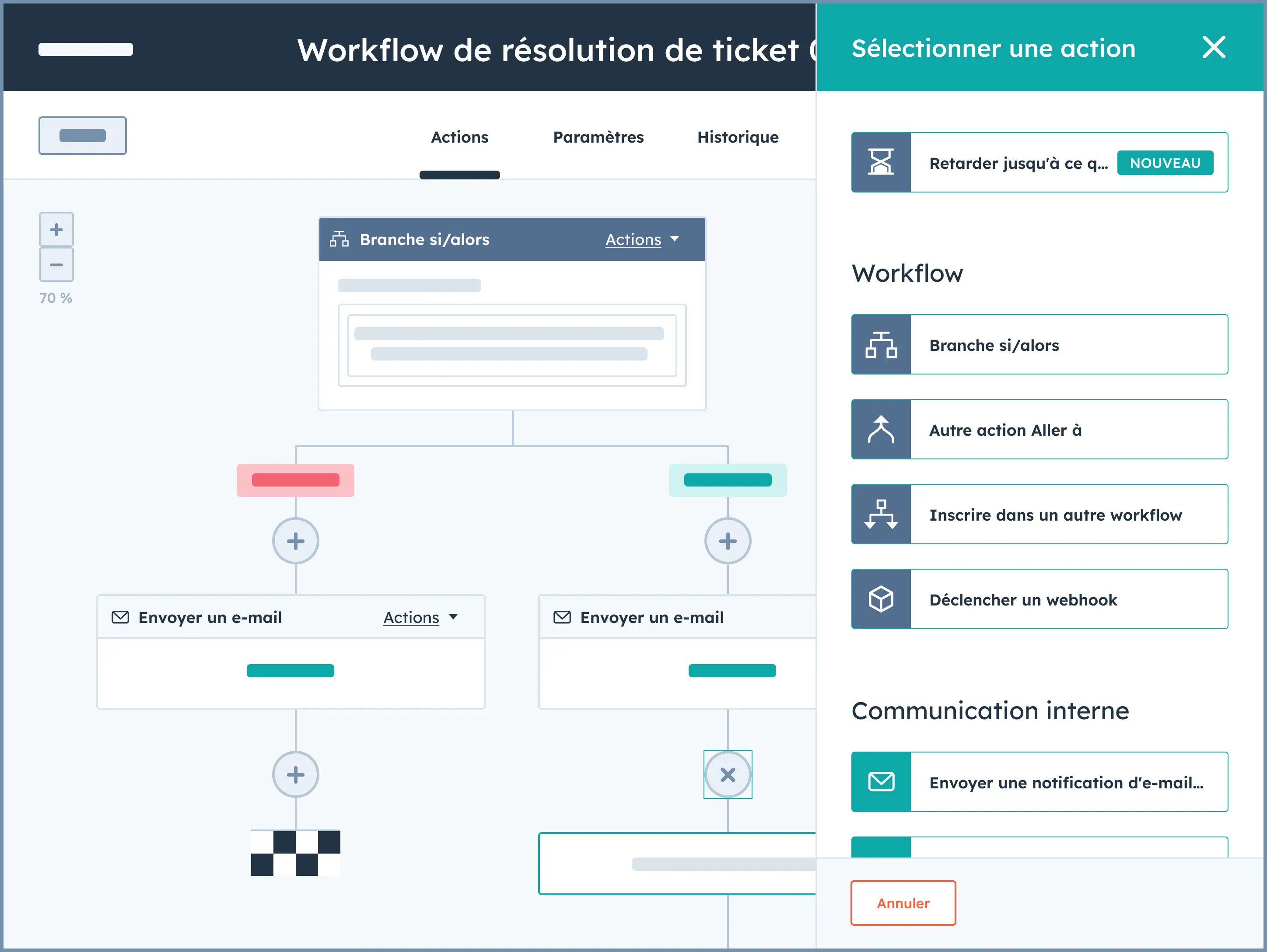
HubSpot automates the repetitive tasks that slow teams down: ticket creation, assignment, notifications, escalations, status changes or follow-ups. Workflows guarantee consistent application of business rules while cutting handling times and the risk of errors.

HubSpot AI

AI can suggest next actions, automatically qualify certain requests and help agents write answers suited to the customer's context.

Steering

Measure performance in real time

Scaling customer service requires tracking reliable KPIs. HubSpot lets you steer response times, SLA compliance, ticket volumes, team performance and customer satisfaction through custom dashboards and consolidated reports.

HubSpot AI

Artificial intelligence helps detect trends, anomalies or recurring patterns to steer continuous improvement actions faster.

HubSpot customer service reporting
HubSpot AI Customer Agent
Evolution

Evolve customer service with AI

Customer service needs evolve with company growth. HubSpot lets you gradually add new artificial intelligence uses: agent assistance, automatic summaries, conversation analysis or conversational agents. This approach speeds up teams without calling existing processes into question.

HubSpot AI

The new HubSpot AI agents handle simple requests, automatically enrich the knowledge base and assist teams in their decisions, while leaving agents in control of complex situations.

Copernic in numbers

800+ clients supported.
You could be next.

800+clients supported
1,200HubSpot hubs implemented
130HubSpot certifications
4HubSpot accreditations

Key takeaways

A clear organization.
Customer service that scales.

Scaling your customer service means structuring processes, centralizing customer data and automating repetitive tasks to handle more requests without degrading service quality. At Copernic, we build a clear organization first, then speed it up with CRM, automation and AI.

  • Structure handling processes
  • Centralize customer knowledge in the CRM
  • Automate assignment and repetitive tasks
  • Develop self-service and the knowledge base
  • Steer SLAs and customer satisfaction
  • Assist agents with AI

FAQ: scaling your customer service

Why scale your customer service?

Scaling your customer service lets you handle a growing volume of requests while guaranteeing consistent service quality. By structuring processes, data and tools, companies improve customer satisfaction, cut handling times and increase the productivity of their teams.

How do you improve customer service productivity?

Productivity improves by removing repetitive tasks, centralizing customer information and automating low-value handling. Agents can then spend more time on complex requests and supporting customers.

What is the role of a CRM in customer service?

A CRM centralizes interactions, customer data and processes in a single platform. It eases collaboration between teams, improves request tracking and provides the KPIs needed for performance management.

Can artificial intelligence replace agents?

No. AI assists teams by summarizing conversations, suggesting answers or automating certain tasks. Complex situations, customer relationships and decision-making remain in the hands of staff.


Which KPIs should you track to steer customer service?

The main KPIs are response times, SLA compliance, first contact resolution rate, CSAT, NPS, ticket volume and team workload. Tracking them helps keep improving processes.

Is HubSpot suited to growing customer service teams?

Yes. HubSpot lets you centralize requests, automate processes, track performance and gradually add artificial intelligence to support teams as volume grows.

How do you succeed with a customer service scaling project?

Success rests on a structured approach: auditing existing processes, defining a target organization, centralizing data, automating repetitive tasks and supporting teams as they adopt the new tools.

Faster answers. Better answers.

Scaling customer service is not just about rolling out a CRM or automating tasks. It is about building an organization able to offer a consistent customer experience, gain efficiency and support your company's growth for the long term. Let's talk about your challenges and identify together the most relevant levers to structure your customer service.