Smart lead qualification
AI identifies the prospects most likely to convert by analyzing their interactions, CRM data and intent signals. Sales teams focus their efforts on the most relevant opportunities.
We structure your sales organization before configuring it in HubSpot. A governance, process and performance management project, not just a tool project. A challenge that starts in SMBs and grows harder in mid-sized companies, when marketing and sales are spread across several sites or business units.
Marketing and sales alignment has become a priority for leadership teams, not as a fad, but because the sales context has changed. Buying journeys are getting longer, data is multiplying and every team must prove measurable business impact. Understanding these shifts explains why a CRM alone no longer guarantees sales performance.
A B2B prospect reads several pieces of content, talks to different people and compares several vendors before contacting a sales rep. This longer, more autonomous journey blurs the line between marketing and sales: the same prospect can be followed by both teams without either having a full view of their journey. Without a shared framework to qualify and share information, each team works with a partial view of the customer, which slows decisions and weakens the sales relationship.
What we see
At Copernic, we see that the best-performing companies are not the ones generating the most leads. They are the ones that know how to convert them together.
Companies now collect huge volumes of data on their prospects: web behavior, sales interactions, purchase history. This data only has value if it is reliable, centralized and shared across teams. Yet in many organizations, marketing and sales use different definitions of the same lead, which multiplies duplicates and inconsistencies. Poorly governed data becomes a source of friction rather than a performance lever.
What we see
Leadership teams often have plenty of data, but still struggle to make decisions fast. The challenge is no longer to collect more information, but to share the same reading of the data.
In a tougher economic climate, leadership expects teams to prove a clear return on investment. The number of leads generated is no longer enough: what counts is turning them into opportunities, then revenue. This pressure calls for shared performance management, able to measure performance end to end rather than in silos. That is exactly the aim of a RevOps (Revenue Operations) approach: organizing marketing, sales and service around the same performance management.
What we see
Companies that improve their sales performance for the long term do not systematically question their tools. They start by reviewing their organization, processes and responsibilities.
Executive committees ask for shared KPIs that everyone understands, rather than separate reports produced by each team. This pushes marketing and sales to converge on a single sales pipeline (the stages that take a prospect all the way to signature) and on a single source of truth for customer data. Without this convergence, every steering committee turns into a battle of numbers instead of a decision-making aid.
What we see
The best dashboards are not the most complete ones. They are the ones that let marketing, sales and leadership make the same decisions at the same time.
Marketing and sales alignment means getting marketing, sales and RevOps teams to work together around shared goals, processes, KPIs and governance. The aim is to improve lead quality, speed up the sales cycle, make sales reporting reliable and lift company performance for the long term. As a CRM & RevOps consulting firm and HubSpot Elite Partner, Copernic supports organizations through this transformation.
Marketing & Sales alignment is first and foremost an organizational project. HubSpot then becomes its accelerator.
ICP and intent
Centralized acquisition
Shared scoring
Sales qualification
Unified pipeline
Attributed revenue
Retention and upsell
In 30 minutes, a Copernic diagnosis pinpoints the friction points between your teams and the fastest alignment levers to pull.
At Copernic, we believe a CRM is never an end in itself. It is the translation of a strategy, processes and operating rules defined upfront. Without this structure, even the best platform delivers only part of the expected value.
Our approach rests on three inseparable dimensions: strategic and organizational consulting, operational excellence on HubSpot and mastery of data and interoperability. Their combination is what builds an organization able to sustain sales performance over time.
Goal: align marketing and sales around a shared vision, goals and processes, before any technical work.
What we do: we map the existing organization, challenge the ideal customer definition and formalize the handoff rules between teams.
Goal: configure HubSpot so it faithfully runs the organization you defined, with no needless complexity.
What we do: we set up qualification workflows, lead scores and the automations that bring processes to life every day.
Goal: make customer data reliable and ensure interoperability between the CRM and the company's other tools.
What we do: we audit data quality, define CRM governance and connect HubSpot to the tools already in place.
Understand · Think
Understand the current organization and identify friction points between marketing and sales, through interviews and analysis of the existing CRM.
Build · Build
Train teams on the new processes and the tool, then secure adoption during the first weeks with close follow-up of the teams.
Implement · Build
Train teams on the new processes and the tool, then secure adoption during the first weeks: tracking of real usage and quick adjustments.
Steer · Run
Make alignment last with a quarterly review committee that continuously adjusts processes, data and sales performance management.
Aligning marketing and sales teams does not rest on a single tool, a new org chart or a weekly meeting. It is an approach that combines strategy, governance, processes and performance management so that every team works toward the same goals. At Copernic, we build this approach on six complementary pillars.
A high-performing organization starts with a shared vision. Marketing, sales teams and leadership must pursue the same business goals and speak the same language. This vision is the starting point for every decision: ideal prospect definition, qualification criteria, sales priorities, success KPIs.
Our recommendation: write this vision down in a short, shared document, reviewed every quarter with marketing and sales leaders.
When marketing is judged on lead volume and sales on signed revenue, each team optimizes its own metric without caring about the impact on the other. Shared goals, built around revenue generated, reconcile both functions around the same business result.
Our recommendation: replace volume goals with shared conversion goals, measured at every stage of the sales pipeline.
Friction between marketing and sales often comes from a lack of formal rules: who contacts the prospect, how fast, with what level of information? Documenting these rules, especially the SLA (Service Level Agreement) between teams, removes most day-to-day misunderstandings.
Our recommendation: formalize a simple SLA between marketing and sales: lead volume, time to first contact, shared qualification criteria.
A lead qualified by marketing (MQL, Marketing Qualified Lead) is not always recognized as such by sales, who requalify it as a sales qualified lead (SQL, Sales Qualified Lead) using their own criteria. Left uncorrected, this gap skews every report and fuels distrust between teams.
Our recommendation: before configuring a lead scoring model in your CRM, have sales validate the criteria as much as marketing.
CRM governance is the set of rules defining who can create, edit or view data in the CRM (Customer Relationship Management). Without governance, each team bends the system to its own habits, which fragments the very tool meant to bring them together.
Our recommendation: appoint a single CRM owner, responsible for governance, rather than letting each team administer its own slice of the tool.
Reliable sales reporting cannot exist without performance management shared by marketing and sales. That means common dashboards, used by both teams, that track performance across the whole conversion funnel rather than on siloed KPIs.
Our recommendation: build one single performance dashboard, fed by the CRM, rather than multiplying reports by team.
Marketing creates the potential.
Sales converts it.
A CRM migration that became the opportunity to redefine Marketing, Sales and RevOps processes around a shared vision.
A strategic migration driven by the will to harmonize Marketing and Sales processes.
Different definitions of the qualified lead and unreliable sales reporting.
Process mapping, shared qualification rules and a CRM architecture aligned with the new model.
A clearer organization, documented processes and performance management shared by Marketing and Sales.
What clients say
“We called on Copernic for a CRM audit plus training and support missions to improve sales/marketing alignment. In a few weeks, we managed to agree on a shared vocabulary.”
“Copernic supported us in structuring our sales funnels, their automations and the synergy between the Marketing / Growth team and the Sales team to build a lead gen machine!”
“The Copernic team supports us over the long term in implementing and optimizing our CRM against our Sales and Marketing goals. Many thanks to Camille for her professionalism and availability.”
Scroll →
Reviews translated from French.
When marketing and sales teams work on different data, decisions slow down and opportunities slip away. AI analyzes behavior, qualifies prospects and automatically passes the right information to sales reps, at the right time.
AI identifies the prospects most likely to convert by analyzing their interactions, CRM data and intent signals. Sales teams focus their efforts on the most relevant opportunities.
By analyzing CRM data, AI highlights the stages where prospects drop off, the campaigns that bring in the best customers and the improvement levers between Marketing and Sales.
AI summarizes marketing and sales exchanges (emails, calls, forms, meetings) to give every team member a clear view of the context before any contact.
AI suggests next actions, content to share or priority follow-ups to improve conversion rates throughout the sales cycle.
HubSpot centralizes marketing, sales and customer data in a single CRM. Teams work with the same information, the same KPIs and the same processes, which makes collaboration easier and lifts overall performance.
Centralize all marketing, sales and customer data in a single CRM. Every team works with the same information, the same history and the same view of the prospect, which makes collaboration easier and limits information loss.
AI built into HubSpot
AI Notetaker automatically records meetings, generates a structured summary, extracts decisions and action items, then saves them directly to the CRM record. Marketing and sales teams instantly share the same level of information, with no re-entry.
Define shared qualification criteria and automate the handoff of leads from Marketing to Sales. Teams work on shared rules to pass opportunities along at the right time.
AI built into HubSpot
HubSpot AI identifies the most promising prospects from engagement signals, recommends sales priorities and helps focus efforts on the highest-potential opportunities.
Alignment does not rest on workflows alone. It depends on teams' ability to share field feedback to continuously improve campaigns, content and sales pitches.
AI built into HubSpot
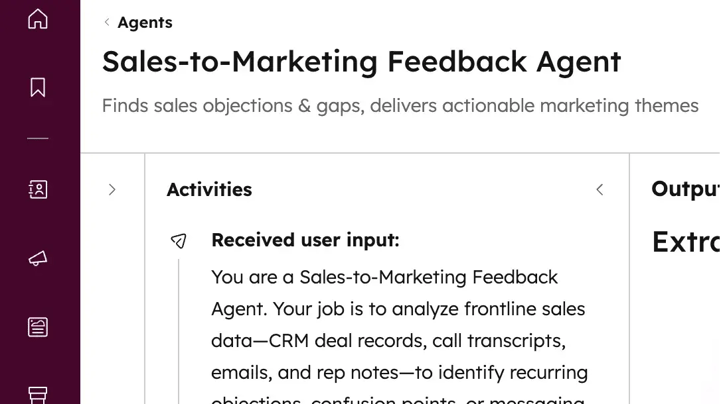
Sales to Marketing Feedback Agent automatically analyzes objections raised during sales calls, identifies prospects' recurring questions and sends concrete recommendations to marketing teams. Content, campaigns and messages evolve with field feedback, with no manual information gathering.
Track the same KPIs to steer sales performance and measure the impact of marketing actions on revenue.
AI built into HubSpot
HubSpot AI detects trends, flags performance anomalies and generates summaries of key KPIs to speed up analysis and decision-making.
Key takeaways
Marketing & Sales alignment is not just about sharing a CRM or holding more meetings between teams. It rests on a shared view of the customer journey, shared goals, clearly defined processes and reliable data. At Copernic, we see the CRM as the foundation of this alignment.
Several signals give it away: leads qualified by marketing but rejected by sales, conflicting reports between the two teams, or no shared definition of a qualified lead.
These frictions often appear gradually, as the company grows and informal processes no longer keep pace with the organization.
Our recommendation: a quick audit of the CRM and of the definitions each team uses is usually enough to measure your current level of alignment.
Silos rarely come from a lack of goodwill, but from goals and KPIs that were not designed together.
Marketing is often measured on lead volume, sales on signed revenue.
Our recommendation: replace these separate goals with shared KPIs, measured across the whole pipeline.
No: marketing and sales alignment is first and foremost organizational and can start independently of any tool.
HubSpot then makes execution easier with a shared CRM and common dashboards.
Our recommendation: clarify your organization before choosing or reconfiguring a CRM.
An initial diagnosis takes 2 to 3 weeks. Formalizing it and rolling it out in HubSpot takes 6 to 12 weeks, depending on your starting maturity.
The timeline depends mostly on organizational complexity, not on technology.
Our recommendation: move in short steps, validated with your teams.
RevOps (Revenue Operations) means organizing marketing, sales and customer service around the same performance management and the same data source.
It does not replace marketing and sales alignment: it provides its structural framework, bringing under one governance the processes, tools and KPIs the two teams had been using separately.
Our recommendation: only introduce a RevOps approach once marketing and sales alignment is stable: it is a natural extension, not a starting point.
The most relevant KPIs are those that cut across both teams rather than those measuring their activity separately: MQL to SQL conversion rate, average time to first sales contact, and rate of leads accepted by sales.
Reporting split by team often hides the real friction points in the pipeline.
Our recommendation: stick to 3 to 5 shared KPIs at most, tracked in a single HubSpot dashboard: piling up metrics dilutes the reading more than it enriches it.
An MQL (Marketing Qualified Lead) is a prospect marketing considers ready based on engagement criteria (downloads, visits, interactions), while an SQL (Sales Qualified Lead) is a prospect sales has validated as truly workable.
The gap between these two qualifications, when undocumented, is the most frequent source of tension between teams.
Our recommendation: have the MQL and SQL criteria defined in the same workshop, with marketing and sales at the table, never in silos.
Ideally, a marketing and sales pair mandated by leadership leads the project, rather than just one of the two functions.
A project driven only by marketing or only by sales often recreates the imbalance it aims to fix, for lack of shared legitimacy on decisions.
Our recommendation: appoint an executive sponsor at kickoff, even if day-to-day management is then delegated to the two team leads.
Go further
In 30 minutes, a Copernic expert reviews your current marketing and sales organization. You leave with a clear diagnosis of your friction points, our first recommendations and a roadmap to build lasting alignment. This conversation comes with no sales commitment: it is advisory time, not a product demo.