
HubSpot consultant: grow your CRM with your needs
Our experts support the ongoing evolution of your HubSpot environment: processes, automations, data, reporting, integrations and new uses, to keep your CRM performing as your organization changes, from the SMB structuring its first teams to the mid-sized company opening new markets.
Your company has changed.
Your HubSpot hasn't yet.
After a few months or years of use, HubSpot rarely evolves at the same pace as the company. New processes appear, teams grow, tools change and change requests pile up. HubSpot support lets you take back control of that evolution without turning every new need into a CRM project.
Your organization has changed, but HubSpot has stayed the same
New offers, new markets, a sales reorganization or a new customer journey: the processes configured at rollout no longer necessarily match how you work today. Your CRM must be able to evolve without calling its whole architecture into question at every change.
Telltale sign
Your teams work around some HubSpot rules because they no longer match how they work.

You use HubSpot without really tapping its potential
The platform is up and running, but some of the available features remain unused or underused. The point is not to switch on more features: a HubSpot expert must identify the ones that can really improve your processes and your performance.
Telltale sign
You add features or licenses without being able to clearly measure what they contribute to usage or results.

Your CRM has grown more complex request after request
Properties, pipelines, workflows and specific rules have piled up as needs arose. Each change seemed relevant on its own, but the whole gradually becomes hard to understand, administer and evolve.
Telltale sign
Before changing a workflow or a property, nobody is really sure of the consequences for the rest of the portal.

Your data quality degrades over time
Duplicates, unused properties, inconsistent values or different entry rules gradually erode trust in the CRM. HubSpot optimization must then address data governance as much as the features that use it.
Telltale sign
Teams check information in other tools or files before trusting HubSpot.

Your reports no longer answer leadership's questions
The indicators built at rollout no longer necessarily match current goals. New KPIs appear, and some of the data needed for steering was never properly structured in the CRM.
Telltale sign
Teams regularly export HubSpot data to Excel or Google Sheets to produce the reports they actually use.
You lack HubSpot expertise available in-house
Your CRM administrator cannot absorb every request, or your organization does not yet justify hiring a dedicated RevOps team. A HubSpot CRM consultant then brings the skills needed to scope, prioritize and deliver the changes.
Telltale sign
Your HubSpot backlog grows faster than your teams can handle it.
What is HubSpot consulting and when should you call on a consultant?
HubSpot consulting is specialized support that helps companies already running HubSpot evolve and optimize their CRM in line with their new goals, processes, data and uses.
Unlike onboarding, HubSpot advisory work happens on an environment that is already live. It can address a one-off issue or be part of ongoing HubSpot support: new processes, automations, reporting, data governance, integrations, administration or adoption.
So the role of a HubSpot consultant is not only to configure the platform. They analyze the business need, challenge the request, measure its impact on what exists, then design an answer consistent with the CRM architecture and how teams work.
Is your HubSpot backlog growing? Let's sort it out.
Let's review your priorities to identify the changes to handle, the ones to challenge and the ones that can wait.
Your information system evolves.
So do your integrations.
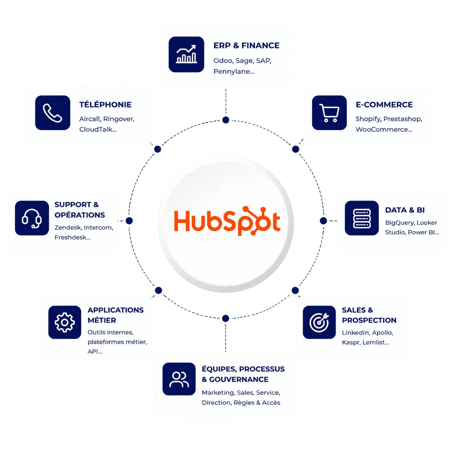
HubSpot is rarely on its own. ERP, telephony, e-commerce, business tools, prospecting software or data platforms produce and use information that is essential to the CRM. When this ecosystem changes, HubSpot flows must change with it.
Our consultants analyze the systems involved, the data exchanged, the sources of truth and the sync rules before changing integrations. The goal is to keep processes consistent and to avoid a local change creating problems elsewhere in the information system.
Our conviction:
a HubSpot change should never be thought through from HubSpot alone. Its impact must be assessed across every system that produces or consumes the data involved.
From business need to HubSpot change
STEP 01
Understand the need before talking about the fix
Model · Think
Define the right HubSpot change
We translate the need into a functional and technical design: processes, data, automations, reporting and integrations. Structural decisions are documented before configuration.
Deploy · Build
Configure, test and go live
Our HubSpot consultants roll out the approved changes and test them on real use cases. This step lets us check the impact on what exists before the changes are released.
Measure · Run
Watch usage and prepare what comes next
We track results and user feedback to identify the adjustments needed. New needs then feed the roadmap and are prioritized by value, urgency and dependencies.
Evolve HubSpot without losing control of your CRM
Our HubSpot support covers the different dimensions that drive CRM performance over time. Every engagement starts from a specific business need or goal before assessing its consequences for processes, data, automations and the existing architecture. Depending on your priorities, our consultants work on a targeted project or steer several changes on an ongoing basis.
Prioritize the HubSpot changes that really create value
We turn team requests into a roadmap structured by business impact, urgency, complexity and dependencies. This prioritization separates quick wins from structural changes, and keeps the CRM roadmap from becoming just the sum of individual requests.
Adapt HubSpot when your business processes change
We evolve Marketing, Sales and Service journeys when your organization, your offers or your business rules change. Pipelines, qualification, responsibilities and handoffs between teams are reviewed before being translated into HubSpot, so the platform stays consistent with day-to-day practice.
Keep data usable as the CRM grows
We evolve the data model, properties, associations and management rules as new needs appear. HubSpot advisory also helps identify data that has become useless and keep conventions clear enough that each team doesn't gradually develop its own model.
Automate the processes that matter without building a monster
We design and evolve workflows around explicit business rules: qualification, assignment, nurturing, data management or internal operations. We also bring in HubSpot AI uses when they deliver concrete value, paying close attention to the data and rules that feed these automations.
Evolve your dashboards with your decisions
We translate new steering needs into indicators you can use in HubSpot. Before building a report, we check that the data and processes it needs actually exist. The goal is to avoid a pile of little-used dashboards and to focus reporting on the decisions teams and leadership have to make.
Evolve HubSpot with your information system
A new ERP, a telephony system, a business tool or a data platform can deeply change HubSpot's role. Our HubSpot consultants scope the flows, sources of truth, sync rules and dependencies needed to evolve the ecosystem without weakening existing processes.
Strengthen the autonomy of your HubSpot teams
We support administrators and users when new processes or features are rolled out. Permissions, documentation, conventions and governance are adapted to the organization's maturity, so outside expertise gradually builds internal skills rather than creating permanent dependency.
HubSpot expertise that keeps pace with your needs
Not every organization needs the same level of support. A specific issue may call for a few days of expertise, while a complex HubSpot environment needs ongoing steering. We adapt the engagement format to your organization, your level of autonomy and the volume of changes to handle.
Targeted engagement
Solve a clearly identified HubSpot need.
Scoping, design and delivery of a specific change.
Ongoing support
Evolve HubSpot month after month.
Regular capacity to handle and prioritize your new needs.
Optimization backlog
Turn piled-up requests into a roadmap.
Qualification, prioritization and step-by-step handling of changes.
Expertise on demand
Tap the right skills when you need them.
Data, automation, reporting, integrations or CRM architecture.
Admin support
Back up your in-house HubSpot lead.
Advice and expertise on complex decisions or configurations.
Outsourced RevOps
Expand your CRM capacity without hiring right away.
Cross-functional steering of processes, data and HubSpot changes.
What clients say
They were listened to.
Their HubSpot moved forward.
An inbound strategy developed
“The Copernic agency helped us develop our inbound strategy while showing attentiveness, commitment and reliability.”
Great teachers, full of ideas
“They support us in rolling out our digital marketing strategy, explaining things clearly, listening closely and proactively bringing ideas.”
Clear teaching, deadlines met
“They explain things very clearly, meet deadlines and make themselves available to answer our questions.”
Reviews translated from French · Scroll →
A ticket gets closed.
A need gets understood.
Consultants who can work across all of HubSpot
Change requests rarely stay within the boundaries of a single Hub. A change to sales qualification can affect marketing, data or reporting; a customer service change may require revisiting automations and integrations.
So our HubSpot consultants work across the whole platform with a cross-functional view of the CRM. The goal is to evolve each use without losing consistency between your teams, your processes and your data.
Sales Hub
Qualification, pipelines, prospecting, sales activities, sequences and forecasting.
Marketing Hub
Acquisition, segmentation, campaigns, nurturing, scoring, attribution and marketing automation.
Service Hub
Tickets, help desk, SLAs, knowledge base, routing and customer satisfaction.
Content Hub
Websites, content, conversion, personalization and use of CRM data.
Data Hub
Data quality, synchronization, enrichment, governance and data automation.
Revenue Hub
Products, quotes, payments and revenue processes when these uses are in scope.
HubSpot expertise that challenges as well as it delivers
Calling on a HubSpot consultant shouldn't mean outsourcing a list of tickets. The partner's role is also to understand the business stakes, challenge requests, anticipate their consequences and propose a sturdier approach when needed.
Copernic combines HubSpot, CRM, data and RevOps expertise to work on both the thinking and the delivery. This dual capability lets us support internal teams in their decisions while delivering the changes they choose.
HubSpot Solutions Architecture Design
Secure changes in complex environments
HubSpot CRM Implementation
Evolve HubSpot with your processes and uses
Key takeaway
Start from the need.
Evolve HubSpot.
HubSpot consulting means supporting a company in the evolution, optimization and governance of its HubSpot environment once it is rolled out. The consultant turns new business needs into concrete CRM changes.
At Copernic, we don't start with the feature to configure. We start from the business need, assess its impact on what exists, then determine how HubSpot should evolve.
- Prioritize changes by business impact
- Evolve processes with the organization
- Automate without making the CRM needlessly complex
- Keep data reliable over time
- Adapt steering to new decisions
- Strengthen in-house teams' skills
Questions fréquentes sur nos consultants HubSpot
Qu’est-ce qu’un consultant HubSpot ?
Un consultant HubSpot accompagne les entreprises dans la conception, l’optimisation et l’évolution de leurs processus, données, automatisations et usages au sein de la plateforme HubSpot.
Quelle différence entre un consultant HubSpot et une agence HubSpot ?
Un consultant intervient principalement sur le cadrage, le conseil et l’accompagnement des évolutions. Une agence peut mobiliser plusieurs expertises complémentaires pour assurer également leur mise en œuvre.
Combien coûte un consultant HubSpot ?
Le coût dépend du niveau d’expertise nécessaire, du périmètre, de la complexité du portail et du mode d’accompagnement retenu : mission ponctuelle ou intervention récurrente.
Peut-on faire appel à un consultant HubSpot ponctuellement ?
Oui. Un expert HubSpot peut intervenir sur un besoin précis : évolution d’un processus, workflow complexe, modèle de données, reporting, intégration ou problématique d’administration. Une mission ciblée est pertinente lorsque le besoin et son périmètre peuvent être clairement définis.
Quelle différence entre un audit et du consulting HubSpot ?
L’objectif est différent. Un audit HubSpot établit un diagnostic structuré de l’environnement existant et priorise les améliorations. Le consulting HubSpot accompagne plutôt l’entreprise dans la conception et l’exécution de ses évolutions. Un audit peut donc précéder un accompagnement de consulting, mais il n’est pas systématiquement nécessaire.
Quelle différence entre l’onboarding et le consulting HubSpot ?
Le moment d’intervention diffère. L’onboarding structure et déploie HubSpot lors de sa mise en place. Le consulting intervient principalement lorsque le CRM est déjà en production et doit évoluer avec de nouveaux processus, objectifs, outils ou usages.
Faut-il avoir un administrateur HubSpot en interne ?
Pas nécessairement. Le niveau d’autonomie nécessaire dépend de la complexité du portail et du rythme des évolutions. Un accompagnement HubSpot peut compléter les compétences d’un administrateur existant ou apporter temporairement une expertise dont l’entreprise ne dispose pas encore en interne.
Un consultant HubSpot peut-il intervenir sur plusieurs Hubs ?
Oui. Nos consultants peuvent intervenir sur Marketing Hub, Sales Hub, Service Hub, Content Hub, Data Hub et Revenue Hub (anciennement Commerce Hub). Une vision transverse est même préférable lorsque les processus et les données circulent entre plusieurs équipes.
Pouvez-vous intervenir sur les intégrations avec nos autres outils ?
Oui. Le conseil HubSpot peut inclure l’analyse et l’évolution des connexions avec un ERP, une solution de téléphonie, un outil métier, une plateforme e-commerce ou un environnement data. Le périmètre dépend du type d’intégration et des technologies concernées.
Un accompagnement HubSpot peut-il être récurrent ?
Oui. C’est même l’un des principaux intérêts du consulting lorsque les besoins évoluent régulièrement. Les demandes sont regroupées, challengées et priorisées dans une roadmap afin de faire évoluer HubSpot progressivement plutôt que d’accumuler des modifications isolées.
What our clients say
“Thanks to their support, we now have a structured roadmap and much better command of our CRM tools.”
Unlimitail, review published on Copernic's HubSpot partner listing
“They support us on several topics and their contribution is highly valued by our teams.”
RoadMate, review published on Copernic's HubSpot partner listing
Go further
- Why work with a HubSpot agency? When it pays off, when to skip it (in French)
- RevOps: a CRM is never finished, it is an engine for continuous revenue improvement (in French)
- From CRM to RevOps cockpit: the HubSpot integrator's job is changing (in French)
- Case study: optimizing sales processes in cybersecurity
Evolve HubSpot at your organization's pace
Rely on our HubSpot consultants to scope, prioritize and roll out your next CRM changes, from data and processes to automations, integrations and reporting.